For the past few weeks, I’ve been doing something that feels faintly illegal.
Not illegal in the “FBI at the door” sense. More illegal in the “this shouldn’t be this easy” sense.
I’ve been vibe coding.
If you haven’t heard the term yet, don’t worry. It sounds like something invented by a 19-year-old with a hoodie and a Discord server. It’s simpler than that.
Vibe coding is when you stop writing code line by line and start describing what you want in plain English. You don’t program. You converse. You sketch with language. The AI translates your conceptual reasoning into something you can click, drag, test and break.
It’s the closest I’ve come to watching an idea move directly from my head into the world without passing through the usual bureaucratic checkpoint of “I'm not sure that's allowed / possible / wanted".
And something very strange happens when that friction disappears.
You stop thinking in constraints.
Three Builds at Once
A few weeks ago, I had three separate builds open at the same time.
Three.
In different tabs.
Each one solving a different problem.
One was an internal AI update tool for work. We’d been talking about sending a weekly email summarising the best things we’d seen in AI that week. The usual process would involve Outlook gymnastics, formatting compromises, someone wrestling with spacing.
So instead I thought: we could vibe code that.
In about an hour I had a working prototype.
You paste in links from the week. It extracts summaries. You either write the narrative or let AI draft it. It assembles everything into a beautifully structured email. You export it straight into Outlook.
A messy, fiddly, time-consuming process collapsed into a single clean interface.
It felt… indulgent.
Then my wife — a lawyer who deals in deals so complex they seem to require their own ecosystem — was describing a monstrous international project she’s working on. Multiple jurisdictions. Operational dependencies. Contractual tentacles everywhere. The current solution is, naturally, a massive document that grows like a fungal organism.
I said, half-joking: I could vibe code something for that. A living system. Links. Dependencies. Visual flows. Everything connected.
She paused.
“If we had that,” she said, “it would be game-changing.”
And that’s when it clicked.
The limitation wasn’t the technology.
It was imagination.
Beyond Thought Experiments
For most of my career, I’ve lived in the conceptual layer.
Scenario planning. Behavioural models. Systems thinking. The kind of work where you can see how things could fit together long before anyone else does. It’s somewhere between theory and architecture.
But building has always been the bottleneck.
You sketch the system. You pitch the system. You explain the system.
And then someone else has to build it.
Vibe coding removes that delay.
It turns conceptual reasoning into something executable.
Not perfectly. Not flawlessly. But fast enough that your thinking can stay fluid.
I found myself coding three conceptual blocks simultaneously, testing how they might integrate, tweaking logic in real time. Not as polished products. As living experiments.
It’s intoxicating.
And like most intoxicating things, it leads you to ask slightly dangerous questions.
What If It Was Physical?
The natural question is: what are the limits?
Right now, the constraints are mostly digital. The quality of the AI. The clarity of your prompts. The occasional stubborn bug.
But what if we removed the screen?
What if vibe coding didn’t just produce websites and tools — but landscapes, buildings, objects?
This started, as these things often do, in conversation.
I was talking to a friend from work, Josh, and we began imagining a different kind of adult space. A camp. A festival-meets-yoga-meets-think-tank. A place for real-world connection as an antidote to increasingly virtual lives.
And then we pushed it.
What if we could design it through vibe coding?
Describe the terrain. Generate the layout. Simulate the flow of people. Adjust structures. Optimise light, sound, logistics.
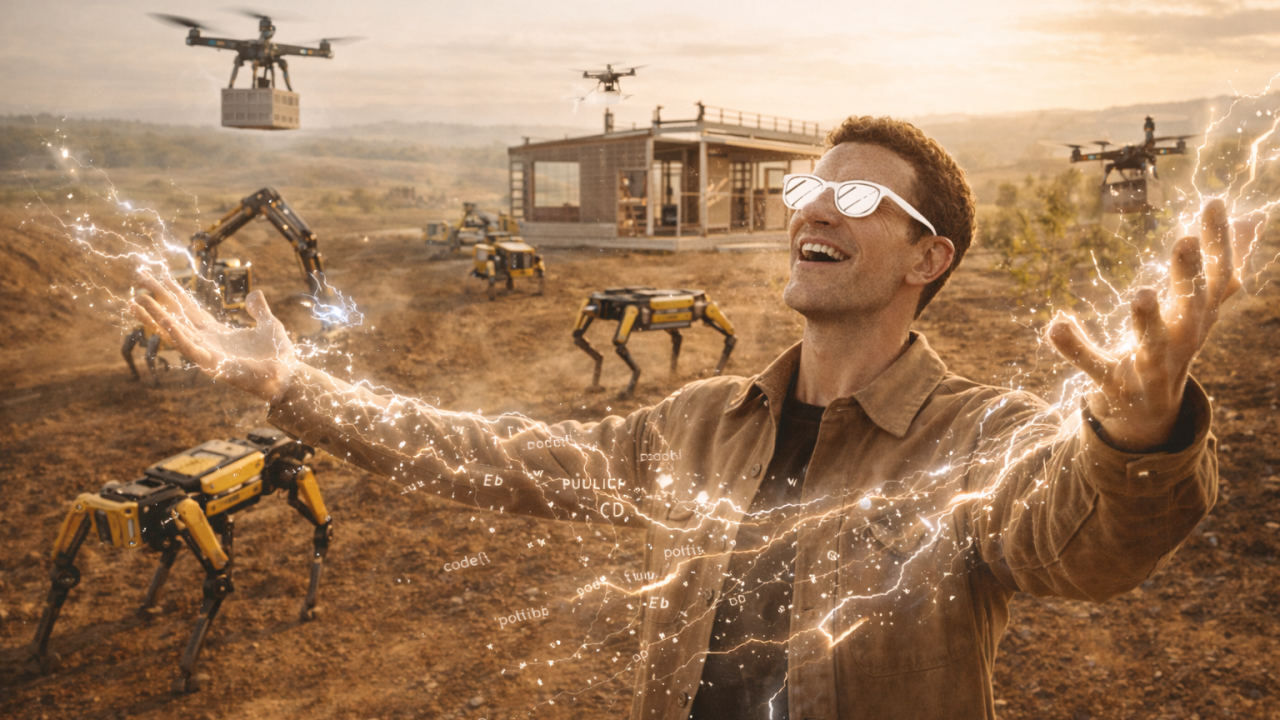
And then — this is the wild bit — what if robots built it?
Not in 2050.
Now.
Because here’s the thing most people haven’t quite clocked yet: the pieces are already emerging.
Robots that can be hired remotely to perform physical tasks. AI systems that coordinate fleets of machines. Low-code interfaces that let non-engineers orchestrate complex workflows. Construction robots that lay bricks. Drones that map land. Robotic arms that assemble structures.
Right now, they’re mostly separated. Industrial. Clunky. Not yet stitched into a seamless conversational interface.
But give it a little time.
Imagine describing a garden:
“I want something that feels slightly wild, with curved paths, native planting, a small fire pit that catches evening light.”
An AI translates that into a plan. A robotic crew prepares the ground. Automated systems lay irrigation. Drones plant. Robotic arms build the structure.
You iterate in real time.
A physical world responding to conceptual reasoning.
That’s not science fiction anymore. It’s integration.
The Strange Bit
The strangest part isn’t the robotics.
It’s what this does to the human role.
When friction drops to near zero, the scarcest resource isn’t labour.
It’s imagination.
We are moving into a world where the person who can conceptualise clearly — who can hold systems in their head, articulate constraints, describe outcomes — becomes disproportionately powerful.
You don’t need to code. You don’t need to weld. You don’t need to draft.
You need to think.
Beautifully.
And that’s why this matters more than the tech itself.
Vibe coding isn’t about replacing engineers.
It’s about collapsing the distance between thought and reality.
And once you’ve felt that collapse — once you’ve watched something move from abstract reasoning to working prototype in an afternoon — it’s very hard to go back.
The future isn’t just automated.
It’s conversational.
And it’s going to be far more amazing — and far stranger — than most people realise.
We’re not waiting for 2050.
We’re already nudging the physical world with language.
That should make you excited.
And just a little bit nervous.