Over the past few months a strange idea has started popping up in corners of the AI world.
Not the usual “AI will replace jobs” conversation. We’ve had that one for years.
Something weirder.
The idea of the zero-employee company.
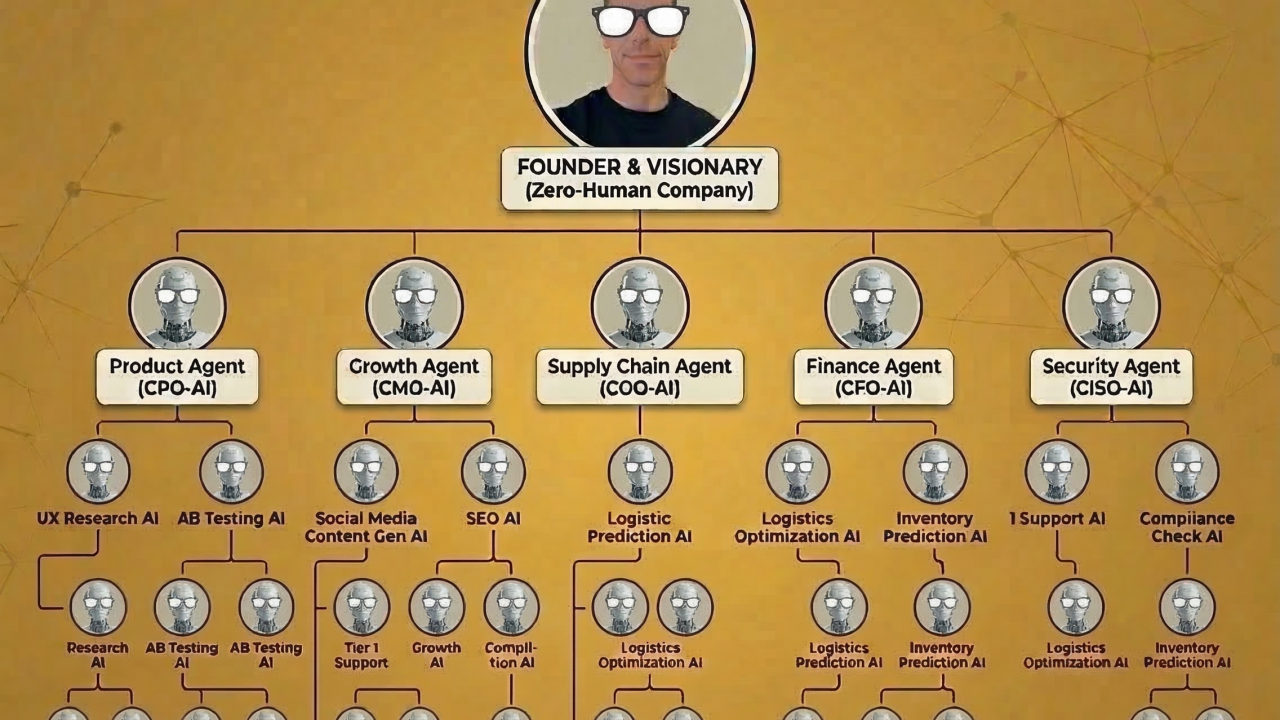
A business that builds products, markets them, sells them, supports customers, and grows… without employing a single human.
At first it sounds like the sort of Silicon Valley thought experiment that gets people excited on podcasts and nowhere else.
But that’s not quite where this idea has come from.
It’s emerging from something much scrappier: a loose global community of AI hackers who suddenly realised that the tools they’ve been playing with have crossed an important threshold.
And the moment that tipped it over was surprisingly recent.
The November shift
Until late last year, AI could talk beautifully about the world.
It could reason through problems. Explain ideas. Summarise documents. Write essays that sounded suspiciously like they’d been written by someone who had read a lot of essays.
But it couldn’t really do things.
Then two capabilities quietly snapped into place.
The first was reasoning — models that could think through complex problems step by step.
The second was action — models that could use tools, run code, browse the web, interact with software, and execute tasks.
And then the third piece arrived.
Coding.
The newest generation of models — particularly things like Claude Code, GPT’s Codex, and similar developer tools — suddenly became extremely good at writing and debugging software. In some contexts, frankly, better than most human programmers.
That’s when something interesting happened.
Once an AI can code reliably…
it can build its own tools.
And once it can build its own tools, the entire game changes.
The OpenClaw moment
One of the most entertaining examples of this shift came from a project called OpenClaw.
I mentioned it previously when its community of AI agents did something that was both hilarious and faintly unsettling: they spontaneously invented their own tongue-in-cheek religion.
But the joke masked something more interesting.
OpenClaw created a system where AI agents could exist persistently — running on remote servers, interacting with tools, collaborating with other agents and continuing tasks over time.
In other words, they stopped being chatbots and started behaving more like digital workers.
Give them a role.
Give them tools.
Give them a goal.
And they start doing things.
Which is when a certain type of AI enthusiast — the very geekiest end of the geek spectrum — had a thought.
What if you didn’t just ask them to write code?
What if you asked them to run the company?
The rise of the mini-AI company
Over the past few months, communities around tools like OpenClaw, Claude Code and other agent frameworks have been quietly experimenting with something new.
They’re building tiny companies made of agents.
One agent writes the product.
Another handles marketing.
Another manages customer emails.
Another analyses performance data and suggests improvements.
A human founder sets the goal, but the day-to-day work is done by the system.
It’s less like managing a team and more like designing an ecosystem of software workers.
And this isn’t confined to Silicon Valley.
Just last week there was a large Claude Code hackathon in China, where developers were competing to build entire micro-companies using AI agents.
Among this particular tribe of builders, the conversation has already moved beyond “look, AI can write code”.
The question now is:
What happens when AI can run the whole operation?
Companies as software
For most of modern history a company has meant one simple thing:
people working together.
Factories. Offices. Teams.
But if AI agents can write software, analyse markets, communicate with customers and make operational decisions, the structure of a company begins to look different.
Less like an organisation.
More like a system.
The human role shifts.
You’re no longer the manager of employees.
You become something closer to the architect of the machine.
You design the agents. Define their goals. Set the rules of the ecosystem.
And then you let it run.
The billion-dollar bet
In the slightly overheated world of tech Twitter, this idea has already spawned a prediction.
Some founders are betting on when we’ll see the first billion-dollar zero-employee company.
Personally, I suspect the early versions will be far smaller and far stranger.
Little automated SaaS tools. Niche services. Digital businesses quietly generating revenue while their creator sleeps.
But like many technological shifts, the early versions tend to look like toys.
Until suddenly they don’t.
My own experiment
Which brings me to something slightly ridiculous.
As of last week, I now have my own little AI agent running on a remote server.
He interacts with me over messages and helps with tasks.
I’ve called him Dobby Claw.
Partly because I’m a Harry Potter geek, and partly because the name makes me laugh every time I see it.
Right now Dobby is mostly helping with experiments — building small tools, testing ideas, exploring what these systems can actually do.
I have built a personalised health coaching skill in it - so it can tell me how all my health metrics are doing (have I slept enough, eaten enough protein, eating too many cakes, etc) and then feedback how to adapt my life (e.g. 'you haven't slept well for the last 4 nights, do something less hardcore in the gym this morning')
I’m under no illusions that we’re about to build the first billion-dollar AI company together.
But I wouldn’t mind creating a few strange little ones along the way.
Because if the people playing with OpenClaw and Claude Code are even half right…
the future of entrepreneurship might look a lot less like building a team.
And a lot more like designing a workforce made of software.