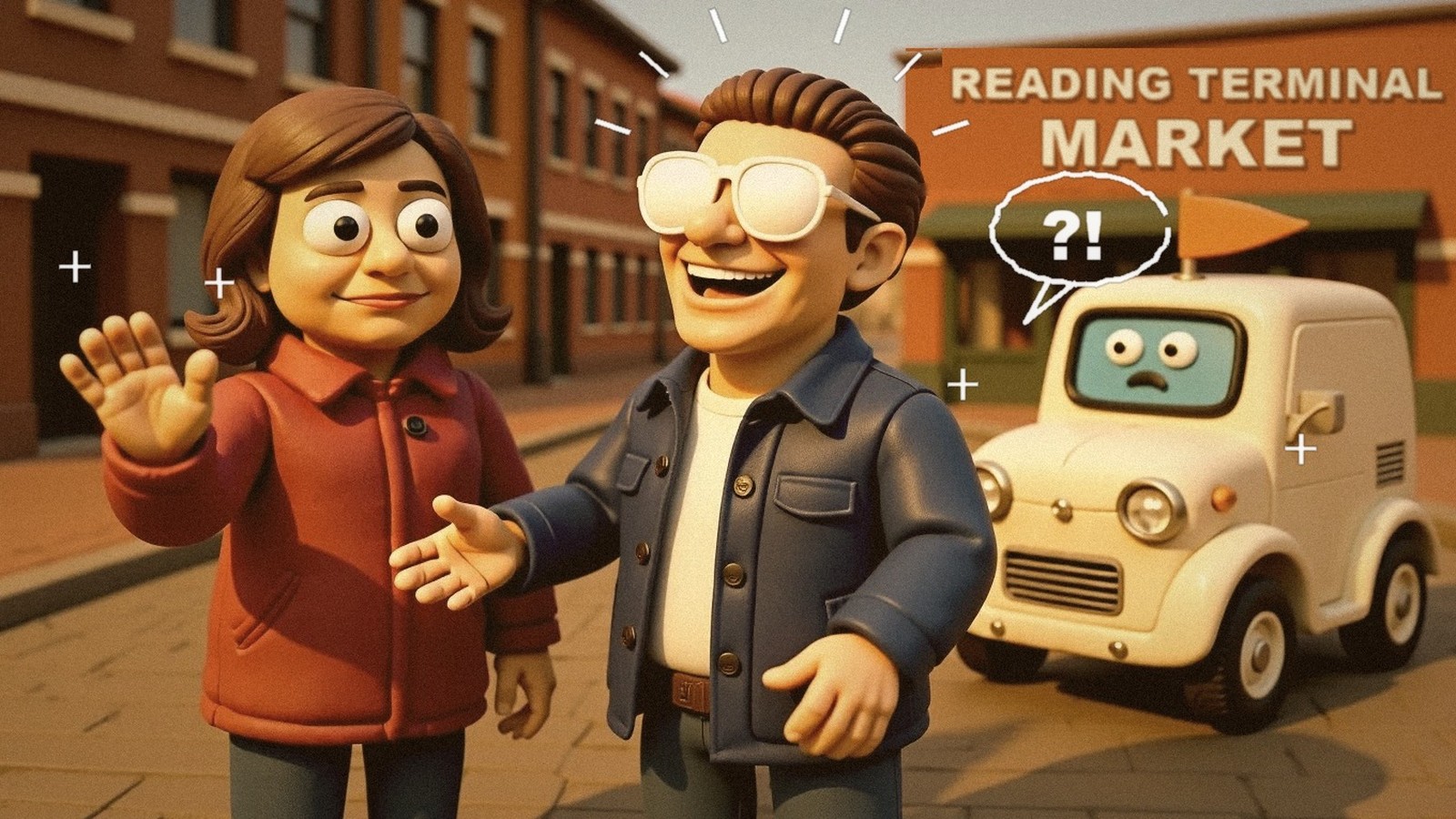
Something small happened on a pavement in Philadelphia last week, and I haven't been able to stop thinking about it.
A woman called Carolyn Marvin stood in front of a delivery robot. It was one of those little white boxes on six wheels that trundle food around city centres, this one working for Uber, on Filbert Street near Reading Terminal Market. She wouldn't let it pass. Police arrived, asked her to move, and when she refused they put her in handcuffs and charged her with disorderly conduct.
It's the reason she gave that got me. She told ABC: "I know they're taking the jobs of human delivery workers and so, I have been protesting them whenever I saw them by standing in front of them and preventing them from going forward."
Whenever she saw them. This was a habit. She'd done it before on Broad Street in September, and when a reporter asked whether she'd carry on, she said, "I do. Why not?"
I covered it on Briefly AI this morning, and my first instinct was to treat it as a quirky end-of-show story. A person versus a sandwich robot. But the more I sat with it, the more it felt like one of the oldest scenes in the history of work, playing again on a much smaller stage.
We've been here before
In March 1811, in the villages around Nottingham, men started turning up at night with hammers.
They were framework knitters, skilled workers who made stockings on hand-operated machines, and they broke into workshops and smashed the frames. They signed their letters in the name of "General Ludd" or "King Ludd", after a probably made-up apprentice called Ned Ludd who, so the story went, had smashed a frame in a fit of rage years earlier. Within a year the movement had spread to the wool croppers of Yorkshire and the cotton weavers of Lancashire, where in April 1812 a crowd burned down Westhoughton Mill and its power looms.
The government's response was ferocious. In February 1812 Parliament passed the Frame Breaking Act, which made smashing a machine punishable by death. At one point there were more British soldiers deployed against the Luddites in the north of England than Britain had fighting Napoleon in Spain.
One person stood up for them in the House of Lords. A 24-year-old Lord Byron, in his maiden speech, asked his fellow peers: "Will you erect a gibbet in every field, and hang up men like scarecrows?"
They more or less did. In January 1813, seventeen men were hanged at York after the attack on Rawfolds Mill and the murder of a mill owner. By 1816 the movement was over.
The bit we usually leave out
Here's the thing I find fascinating. We've turned "Luddite" into an insult for someone who can't work their phone, or who's scared of the future. The real Luddites would have been baffled by that.
The Luddites were skilled people who had been using machines for generations. A stocking frame is a machine. What made them angry was how the new machines were being used, to drive down wages and replace apprenticed craftsmen with cheap untrained labour. Brian Merchant's brilliant book Blood in the Machine tells this story beautifully. Their fight was with the people who owned the machines, over who got to keep the gains.
And they had good reason to be worried. Look at what happened to the handloom weavers. According to research from Daron Acemoglu and Simon Johnson (the economists who went on to win the Nobel), in 1806 a handloom weaver earned roughly twice what a factory worker did. By 1820 they earned 25% less. Their real wages eventually fell to about a quarter of their peak, and hundreds of thousands of them stayed in the trade anyway, because what else were they going to do?
Even the economists of the time changed their minds. David Ricardo, the great champion of free markets, added a whole new chapter to his book in 1821 called "On Machinery", admitting that he'd been wrong to assume machines would always be good for working people.
Britain did get enormously richer. But for most ordinary workers, real wages barely moved for decades. Acemoglu and Johnson put much of that down to power: the workers had no legal right to bargain collectively and no political voice to push for a fairer share.
So when we tell ourselves the comforting version ("the Luddites lost, progress won, and everyone ended up better off"), we skip about two generations of people who didn't.
So what about the robot?
I should be honest about where I stand here. I run a small AI workforce. Agents write, research, build and publish things for me every single day, and I love it. If anyone is the bloke who owns the robot in this story, it's probably me.
Which is exactly why the Philadelphia story stuck with me.
Carolyn Marvin isn't going to stop delivery robots. Nobody smashing a stocking frame stopped the Industrial Revolution either. The machines are coming, and in plenty of ways that's wonderful. But the question the Luddites were really asking was "who gets the benefit when the machines arrive?" Two hundred years later, that question is standing on a pavement in Philadelphia, arms folded, refusing to move.
What Acemoglu and Johnson argue, and what I find genuinely hopeful, is that the outcome isn't fixed by the technology. It depends on choices. Whether we use AI mainly to cut people out, or to give people new things to do. Whether the people doing the work have any say in how it's rolled out. In 1812 those choices were made by mill owners, with the army behind them.
This time, we get to watch it happen in real time. And plenty of us are the ones making the choices.
The question
So here's what I keep coming back to.
Is this the same old march of progress, the one we always end up calling inevitable? The machines arrive, a few brave or stubborn people stand in the way, they get arrested, and in fifty years we laugh at them the way we laugh at the Luddites?
Or is there a different story to be told this time? One where we remember what the Luddites were actually asking for, and give a better answer.
I genuinely don't know. I'm excited about where this goes, and a little bit uneasy about who gets left standing on the pavement.
What do you think?
I cover stories like this every morning on Briefly AI, a short daily AI news podcast, written and voiced by my AI clone. Yes, I see the irony.