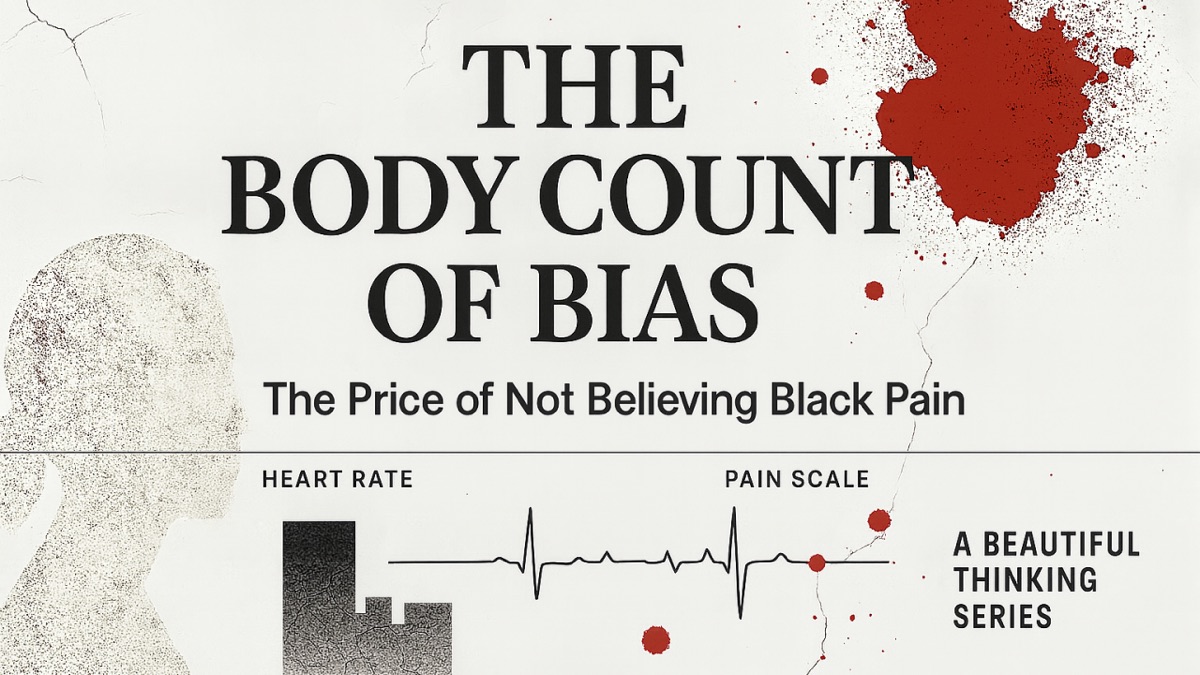
She walked off the plane and straight into the emergency room.
A new city. A familiar crisis.
She was just 18. Alone in Los Angeles.
She has sickle cell disease. That day, her blood had turned on her—warped cells clogging tiny vessels, starving her organs of oxygen, unleashing pain so brutal it doesn’t feel like pain anymore. It feels like suffocation from the inside.
She was calm. Polite. In agony.
She told the nurses what she needed. Told them what had worked before. Told them what happens if she’s forced to wait. She'd done this dance many times before.
But she’s Black. A woman. And in pain.
So they made her wait. Treated her like a liability. Like someone chasing a fix.
Eventually, they agreed to medicate her—but not with what she requested. They insisted on a different drug. One that made her feel groggy, out of control, unsafe.
She tried to explain, but they’d stopped listening. Her pain had already been filed under suspicion.
Hours later, still dizzy, still hurting, they decided she was ready to go.
She wasn’t.
She told them that. She begged them to wait.
Instead, they sent two male porters to her bedside. Not nurses. Not doctors.
Porters.
They lifted her—slight, sweating, half-sedated—and wheeled her out of the ward.
They left her in the hospital lobby.
Alone.
She was lucid enough to open her phone. She went live on Instagram. A friend saw the stream. Recognised the hospital. Came to find her.
That livestream saved her.
This isn’t a parable. It’s a true story—a Black woman I know, living with sickle cell disease.
And it’s not rare. It’s routine.
I’ve spoken to other women who tell me: before going to the ER in crisis, they fix their hair. They do their makeup. They pick their nicest clothes. Because they know it might be the difference between being treated with care—or with suspicion.
"Imagine being at a 10 out of 10 on the pain scale, and still worrying about whether your hoodie makes you look like a junkie."
One man I spoke to—a police officer—told me this:
"I was shot in the leg once. Sickle cell pain is worse."
That’s the bar we’re dealing with.
And even then, Black patients still have to plead to be believed.
The Data Doesn’t Lie—But It Does Hurt
Black patients are 22% less likely to receive any pain medication than white patients with the same symptoms. That’s from a meta-analysis of over two decades of clinical studies.
In emergency rooms, Black children with appendicitis are significantly less likely to receive opioids than white children. Same diagnosis. Same pain. But different assumptions. They are just children!!!!!!
For adults? In one ER study, 74% of white patients with broken bones received pain medication. For Black patients? Just 50%.
In the UK, Black women are 8% less likely to receive an epidural during labour. But 58% more likely to be knocked out under general anaesthetic for a C-section. Not because their pain is less. But because it’s listened to less.
"This isn’t just unconscious bias. This is institutionalised disbelief."
Bias by Design: Algorithms That Underserve
One hospital algorithm in the US used healthcare cost as a stand-in for illness severity. Since the system spends less on Black patients—thanks to decades of under-treatment(!!!)—the algorithm assumed they were healthier.
When the bias was corrected, the number of Black patients flagged for extra care more than doubled.
Even the formulas used to assess kidney function once “corrected” for race—inflating Black patients’ scores and delaying critical care. Many institutions are now reversing this. But the damage is done.
Education in Monochrome
In four major medical textbooks, 95% of images show light skin. Except one chapter: STIs. That’s where dark skin shows up.
If that doesn’t make your stomach drop, and your skin crawl, read it again. 95% of images show light skin. Except one chapter: STIs.
This absence isn’t just cosmetic—it’s clinical. Conditions like melanoma are diagnosed later in Black patients. Survival rates are lower. Why? Because doctors weren’t shown what to look for.
Even dermatologists report lower confidence diagnosing on darker skin tones. Less confident. Less accurate. More fatal.
Trials That Don’t Look Like the People They Serve
In 2020, 75% of participants in new drug trials were white. Only 8% were Black. Despite the fact that Black people make up around 13% of the U.S. population.
That means drugs are tested on one population—and rolled out to everyone else.
And that’s not just unfair. It’s dangerous.
Some drugs work differently across genetic groups. Some cause side effects. Some are less effective. If you’re not represented in the trial, you’re part of the post-market experiment.
"Even the pigs used in preclinical testing are pink."
And the Cost?
Over $450 billion a year in the U.S. alone.
That’s the estimated economic toll of racial health disparities. Missed work. Excess treatment. Premature death. Systemic neglect.
But the real cost? The one you can’t print on a balance sheet?
It looks like an 18-year-old girl. Wheeled out of a hospital lobby. Half-drugged. Still in crisis. Livestreaming her own abandonment.
That’s what bias costs.
And it’s being paid, in pain, by the people the system was never built for.
Firstly, thank you for your time and attention. And please do share if you feel others should see or know this.
Secondly, if this made you angry, and you'd like to get even more angry, and missed the first part of this series about women's health, you can read it here - Women Aren't Just SMall Men https://www.linkedin.com/pulse/body-count-bias-women-arent-just-small-men-harry-sharman--r8kee