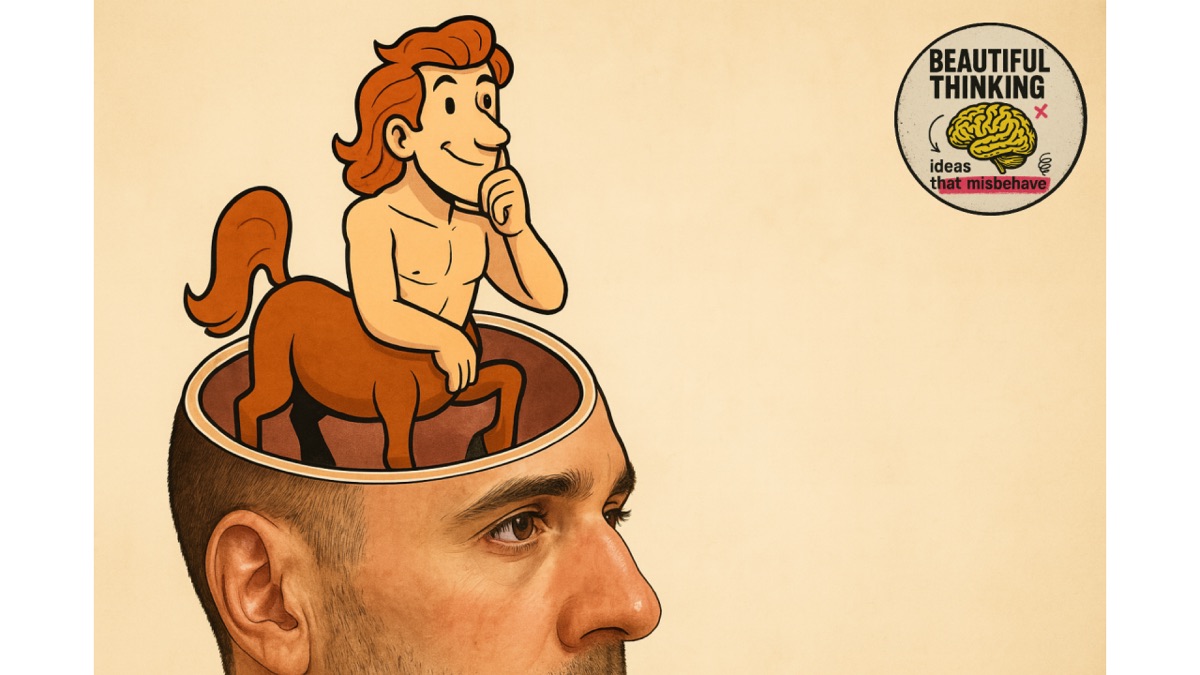
Big news! (Admittedly, you may have missed it—unless you, like me, spend evenings combing Nature for juicy psychology x AI breakthroughs…)
But this one? This is huge.
It’s called *Centaur—an AI model trained on *10 million human decisions, across 160 psychology experiments, and fine-tuned on Meta’s LLaMA 3.1. It doesn’t summarise human behaviour. It doesn’t just spit back stats. It simulates how we make decisions—across domains, scenarios, and contexts it’s never seen before.
And the kicker? Its internal patterns mirror human brain scans. Seriously. This thing doesn’t just act like us. It starts to think like us.
🔬 A Grand Unifying Theory (Finally)
Psychology has always been fractured. Freud had the ego, Skinner had the rat box, Kahneman gave us System 1 and 2, and Behavioural Science built models like COM-B to help people actually do stuff.
But none of these theories truly unified the field. No grand scaffolding. No Theory of Everything.
Just decades of academics lobbing experimental grenades at each other and insisting their framework was right—until a newer, shinier one came along to dunk on it.
As a student, I was taught to treat all these theories with equal reverence. But I couldn’t help noticing: the one based in evolution—the one built on natural and sexual selection—was 1,000x more robust than the others.
And yet, all were put on the same pedestal. As if they were interchangeable.
Now? Centaur doesn’t choose a model. It learns from how we actually decide—flawed, fast, emotional, brilliant—and shows us which patterns hold up across time and context.
This could be it. The red thread. The what and the why. A unified model of human decision-making that links:
-
Effective interventions (like social proof)
Predictable biases (like confirmation bias)
Neural patterns (that mirror the irrationality we live with daily)
⚙️ What This Means for the Rest of Us
Let’s not leave this in the ivory towers of academia. Because the implications are world-changing—and deeply personal to every discipline I work in.
1. Behavioural Science
BS thrives on practicality—models like COM-B work because they’re implementable. But Centaur lets us go deeper. It connects what works to why it works. It links behavioural patterns to brain-level cognition. And it opens the door to testing interventions before we deploy them.
→ It turns BS into a predictive science, not just a reflective one.
2. Strategy
Strategy is about pulling together the puzzle pieces: humans, culture, market, brand.
Centaur strengthens the human pillar—massively. Now, instead of guessing how people might act, we can simulate how they will decide.
Strategists won’t disappear. But they’ll evolve: From insight-hunters to decision-shapers. From decks to cognitive labs.
3. Marketing & Advertising
Forget testing a message after the campaign’s live. Centaur means you can test your thinking before you even brief the creative team.
It could finally prove what we already suspect: That bold, creative work doesn’t just “win awards”—it performs better, neurologically and behaviourally.
→ Creativity isn’t a risk. → Playing it safe is.
4. Healthcare
This is the big one. We work in a world where treatments exist—but uptake doesn’t. Where gene therapies can cure—but fear, distrust, or friction stop patients from accepting them.
Centaur could help us simulate the paths that lead to treatment. Understand how people actually decide when the stakes are life and death.
But here’s the warning (thank's to both Spiderman and probably the French Revolution):
With great power comes great responsibility. Because if you’re a bad actor? This works for you too.
We’ve already seen what happens when you combine persuasion and profit with no ethical brakes. (Perdue Pharma and McKinsey, anyone?)
Centaur is a scalpel. Whether it heals or harms depends on who’s holding it.
🧭 So… What Now?
If you’re a junior strategist, planner, scientist, or thinker: Learn the shit out of this. It’s not ready for plug-and-play use in your workflow—yet. But it will be. And when it is, the people who understand it will be lightyears ahead.
This isn’t the end of human understanding. It’s the beginning of something better.
Something predictive. Something grounded. Something beautiful.
TL;DR
Centaur is the first AI to simulate how we decide—not just what we do. It may be the start of a Grand Unifying Theory of Psychology. It won’t just disrupt research. It’ll rewrite it. And if you’re still running surveys and focus groups without asking, “Could we simulate this?”— you’re about to get replaced by someone who will.
If you like your science sharp and your thinking a little bit dangerous, → Subscribe to Beautiful Thinking → Share it with your contrarian friend → And let’s build what’s next