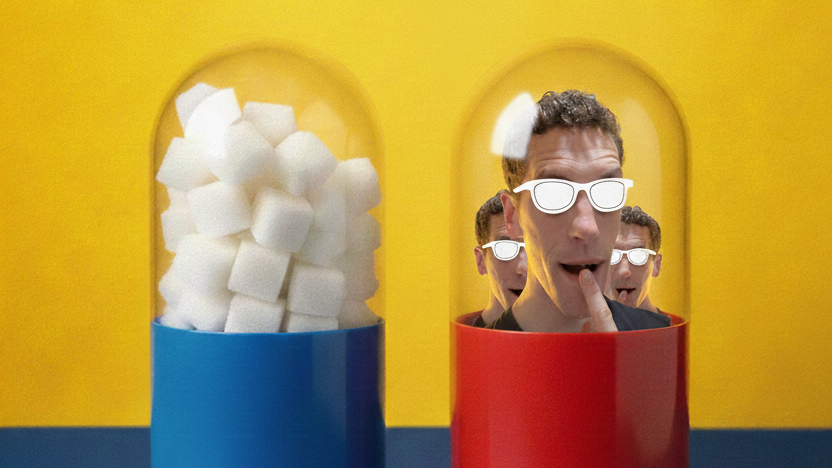
I’d like to try and persuade you of something.
Not gently suggest. Convince.
I want to convince you that the placebo effect is one of the most beautiful things in medicine.
Which is a slightly odd claim, because the placebo effect has somehow ended up with terrible PR. In everyday language, calling something a placebo is practically an insult. It implies fakery. Illusion. A polite way of saying “that didn’t really work.”
But if you look at what is actually happening, the opposite is true.
The placebo effect isn’t evidence that humans are easily fooled.
It’s evidence that the human brain is far more powerful—and far more connected to the body—than we tend to appreciate.
Why Medicine Tries to Remove It
Before we get carried away, we should start with a small moment of scientific realism.
Modern medicine works very hard to remove the placebo effect.
If a pharmaceutical company develops a new drug—let’s say a pill designed to reduce pain—researchers don’t just give it to people and see if they feel better.
Instead, they run a trial.
Some people receive the real drug. Others receive a pill that looks identical but contains nothing active—a placebo.
Nobody knows which they’re getting.
Then the question becomes simple: does the real drug help more than the placebo?
If it does, the drug works.
If it doesn’t, the improvement people experienced probably came from expectation, attention, care, time passing, or the body’s own natural ability to settle symptoms.
This is why clinical trials are designed to beat placebo.
And that’s absolutely the right thing to do. Sugar pills cannot kill bacteria, shrink tumours, or cure infections. Medicine learned the hard way that people can feel better even when a treatment itself does nothing.
But here’s the fascinating twist.
In the process of trying to eliminate the placebo effect from experiments, scientists began to realise something rather wonderful:
The placebo effect itself is not imaginary.
It’s biology.
The Brain That Makes Its Own Painkillers
One of the most elegant demonstrations of this involved people with pain.
Researchers gave volunteers pills they were told would reduce pain. In reality, the pills contained nothing active at all.
And yet many participants reported that their pain eased.
Now, at this point you might reasonably suspect people were simply convincing themselves they felt better.
So the scientists tried something clever.
They gave those same participants a drug called naloxone, which blocks opioid receptors in the brain. Naloxone is normally used in emergency rooms to reverse heroin overdoses.
When the researchers administered naloxone, the placebo pain relief disappeared.
Which meant the sugar pill had not simply tricked anyone.
The expectation of relief had triggered the brain to release its own natural opioids—chemicals remarkably similar to the ones in drugs like morphine.
The brain had effectively manufactured its own painkiller.
The pill was sugar.
But the response was pharmacological.
The Curious Theatre of Medicine
Once researchers started looking more closely, the details became almost charming.
Blue pills tend to make people feel calmer or sleepier.
Red pills tend to feel more stimulating.
Capsules tend to work better than tablets.
Injections tend to work better than capsules.
And—my favourite detail of all—expensive placebos work better than cheap ones.
Which suggests the brain is not responding randomly.
It’s responding to signals.
If the treatment looks serious, elaborate, or impressive, the brain seems more willing to activate its internal machinery for relief.
In other words, the brain isn’t simply reacting to chemistry. It is reacting to meaning.
When the Body Responds Even Without the Trick
For a long time scientists assumed placebo effects only worked because patients were being deceived.
If you knew the pill was inert, surely the magic would vanish.
Then researchers tried something wonderfully mischievous.
They ran a study with patients suffering from irritable bowel syndrome—a condition that can cause severe abdominal pain and digestive chaos.
Instead of hiding the placebo, the researchers told patients exactly what it was.
They handed them a bottle clearly labelled PLACEBO.
One participant, a woman named Linda Buonanno, was understandably unimpressed.
“A placebo?” she thought. “Are you kidding?”
But she took the pills anyway.
Three weeks later, her symptoms had dramatically improved.
When asked about it afterwards, she said something that perfectly captures the mystery of this whole field:
“I didn’t have a clue what was going on. I still don’t. All I know is that it works.”
Which is a wonderfully human response.
Because the scientists weren’t entirely sure either.
Where the Magic Stops
Now, before this starts sounding like an argument for replacing medicine with positive thinking, we should keep our feet firmly on the ground.
Placebos have limits.
They do not kill bacteria. They do not eliminate viruses. They do not shrink tumours.
If you have pneumonia, a sugar pill will not clear the infection.
What placebo effects tend to influence are things the brain itself regulates or interprets:
Pain. Fatigue. Mood. Motor symptoms in conditions like Parkinson’s disease.
They change how illness is experienced, rather than eliminating the underlying disease itself.
And that distinction matters enormously.
It’s the reason real drugs must still beat placebo in clinical trials.
The Shadow Side
There’s also a darker mirror image called the nocebo effect.
If expectation can produce relief, it can also produce harm.
In one clever study investigating side effects from cholesterol drugs, participants alternated between taking the real drug, taking a placebo, or taking nothing at all.
Many of the symptoms people reported appeared during both the real drug and the placebo.
The expectation of side effects had been enough to help create them.
Which leads to a quietly sobering thought.
Words matter.
Tell someone a drug may cause nausea and a significant number of people will feel nauseous—even if the pill itself is completely inert.
Expectation cuts both ways.
The Point I’m Trying to Sell You
So yes—medicine absolutely should continue trying to beat placebo.
But the placebo effect itself is not something embarrassing or trivial.
It’s something extraordinary.
Because it reveals that the human brain is not simply directing the body like a distant manager shouting instructions.
It is intimately woven into how the body feels, responds, and sometimes heals.
Inside each of us sits a prediction machine capable of releasing neurotransmitters, hormones, and painkillers in response to meaning, context, and expectation.
In other words, each of us carries a small chemical factory between our ears.
A secret pharmacy, quietly responding to the stories our brains believe about what is happening to us.
And if that isn’t a rather beautiful reflection of how the human brain works, I’m not sure what is.