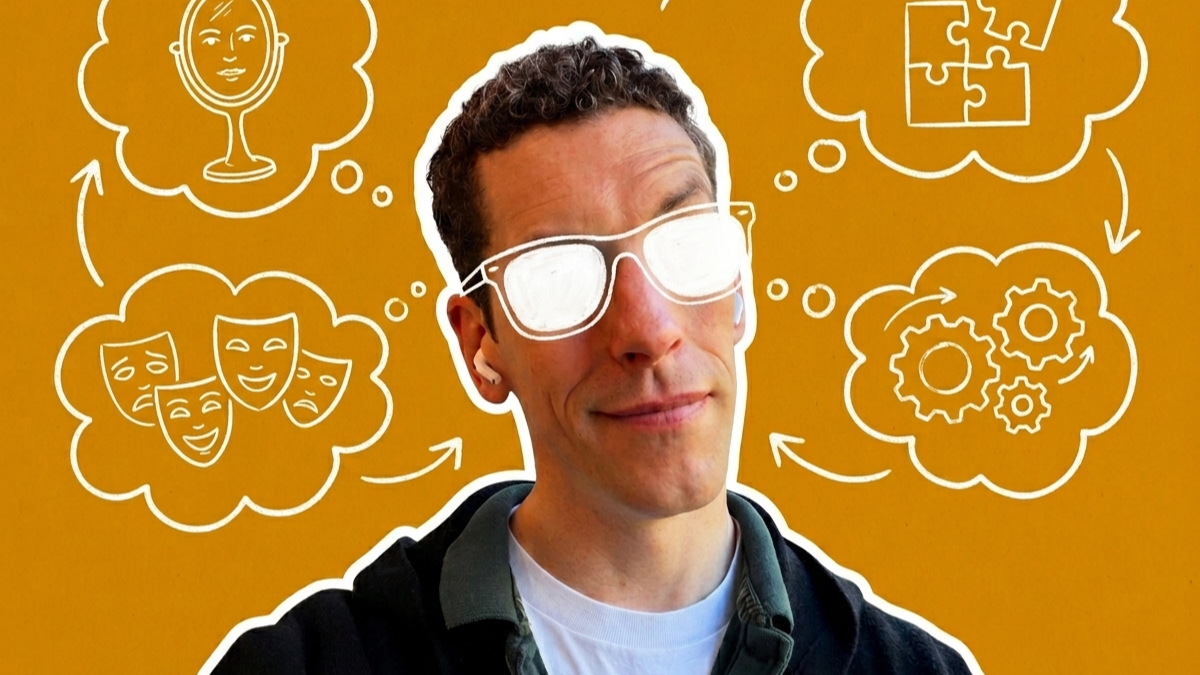
I remain convinced that the biggest challenge in workplace AI adoption is not technical.
It isn't really about access. It isn't mainly about training. It isn't even, in the end, about policy, governance, or whether Keith from compliance starts visibly ageing every time somebody says "let's just run it through ChatGPT."
Those things matter, of course. But they are not, to my mind, the deepest point of friction.
The deepest point of friction is identity.
More specifically: what AI seems to threaten in a person's sense of self. Their competence. Their distinctiveness. Their value. The quiet internal story that says, this is what I'm good at; this is why I matter here; this is what makes me me at work.
That, I suspect, is where a great deal of the resistance lives.
And the more I read around this, the more I think the research points in the same direction.
Because if work were just a bundle of tasks, AI adoption would be much easier. We would simply look at the tool, decide whether it helps, and get on with it like sensible adults.
But work is almost never just a bundle of tasks.
Work is where people locate status, usefulness, intelligence, creativity, pride, security, and social standing. It is where they prove things to themselves. It is where they become known for something. So when AI turns up and starts doing some of the very things people have quietly wrapped their identity around, the problem ceases to be operational.
It becomes personal.
We have seen this sort of thing before
One of the reasons I keep coming back to this identity frame is that we already know, from other domains of life, what happens when a major role disappears and nothing meaningful replaces it.
Retirement is the obvious analogue.
Not because work and AI are identical to retirement — they aren't — but because the underlying human machinery is familiar. For many people, retirement is not just the end of a job. It is the loss of structure, status, social identity, daily purpose, and a clear answer to the question, what am I for now? Research on retirement has repeatedly found that social identities and sense of purpose matter enormously to how well people make that transition. People who maintain multiple group memberships and a stronger sense of purpose tend to fare better; those losses can be destabilising in ways that are far more than merely practical. And more broadly, lower purpose in life has been associated with higher mortality risk in older adults.
I am not suggesting AI adoption at work is about to kill people off in the style of some particularly vindictive spreadsheet.
I am saying the feeling is recognisable.
When a role that anchored your identity begins to wobble, people do not respond to that as though they were simply being offered a more efficient stapler. They respond as humans usually do when meaning, status, and self-definition are disturbed: with anxiety, defensiveness, denial, resistance, bargaining, curiosity, grief, reinvention — often all before lunch.
That is why I think this matters so much.
We keep treating adoption like a process problem
A lot of workplace AI conversations still sound as though the barrier is mostly procedural.
Have people had the training? Do they trust the outputs? Do they know the rules? Does the organisation have a responsible use policy longer than a haiku?
Again, all fair.
But I think this framing misses something important. It assumes people are evaluating AI as a neutral productivity tool. A better calculator. A faster assistant. A shinier bit of kit.
Quite a few of them are not.
Quite a few of them are experiencing AI, however quietly, as a challenge to the role they occupy in the world.
Because if you have spent years becoming the writer, the strategist, the analyst, the fixer, the person with the good ideas, then AI does not arrive as some innocent little productivity layer.
It arrives like an unnervingly capable intern who has learned your favourite trick and is performing it back to you with slightly indecent ease.
That lands differently.
And that is why the usual organisational response — more training, more demos, another webinar called something like Unlocking Value Through AI Enablement — often feels strangely inadequate. It is trying to solve an emotional and existential problem with process.
Which is rather like bringing a laminated checklist to a divorce.
What people are really asking
Underneath all the practical questions, I think many people are asking something far more intimate.
If I use this, am I still the writer? If I use this, am I still the strategist? If I use this, what exactly am I contributing? If this thing can do in thirty seconds what I have built a career on doing in three hours, what does that make me now?
That is not technophobia. That is not stubbornness. And it certainly is not always ignorance.
It is a confrontation with selfhood.
There is now research suggesting that people actively reshape their professional identity depending on how AI shows up in the workplace — whether as assistant, partner, or something more dominant. A 2026 paper on occupational identity crafting found exactly that: workers adjust how they understand their role, contribution, and professional self when AI enters the picture.
That rings true to me.
Because adoption is not just about whether a tool is useful. It is about whether a person can use that tool without feeling diminished by it.
Or, better still, whether they can use it and still recognise themselves in the work.
AI is not just changing the work. It is changing the mirror.
This is where the broader identity research becomes useful.
One of the more compelling ideas in the literature is the notion of the algorithmic self — the idea that our sense of self is increasingly shaped not just by introspection and human relationships, but by algorithmic systems that predict, recommend, classify, and reflect us back to ourselves. Another paper makes a similar point via the old sociological idea of the "looking-glass self": we come to know ourselves partly through how we imagine others see us, and AI is increasingly joining that chorus.
That may sound grand and theoretical until you notice how ordinary it has already become.
Your music app decides your taste before you do.
Your shopping feed develops a more coherent view of your aesthetic than you've ever managed.
Your algorithm seems to believe, with total confidence, that you are either the sort of person who needs a standing desk, a magnesium supplement, or a video explaining macroeconomics by a man in a fitted quarter-zip.
And now AI systems do not merely recommend. They respond. They reflect. They collaborate. They suggest. They praise. They nudge.
Which means that identity is no longer just socially negotiated. It is increasingly algorithmically negotiated too.
And once that starts happening at work, adoption stops being a question of "do I know how to use this?" and becomes, at least in part, "what version of me does this tool leave standing?"
Why this matters so much in the workplace
In personal life, identity is already messy enough. But in professional life, it is often more brittle than people realise.
Many careers are built not just on outcomes, but on self-concept.
The person who is known for sharp judgment. The person who is always first to the insight. The person who can write beautifully. The person who can wrestle chaos into coherence. The person who, in a room full of wandering minds and mediocre slides, can still somehow land the thing.
If AI starts doing even some of that, it is not surprising that people wobble.
Because the threat is not always job loss in the crude sense. Often it is something subtler and, psychologically speaking, more destabilising.
It is role erosion. Distinctiveness erosion. The suspicion that what made you special may turn out to have been at least partly automatable.
That is hard to absorb. Harder still in organisations that talk about AI primarily in the language of efficiency, speed, and headcount. If you tell people, explicitly or implicitly, that the future is about getting the same output with fewer humans, do not act shocked when they become a little frosty about adoption.
That is not resistance to innovation. That is a perfectly rational response to identity threat.
The workplace blocker nobody wants to name
This is the bit I think many companies still miss.
People do not resist tools only because they are hard. They resist tools because of what those tools appear to say about them.
About their value. About their replaceability. About whether their hard-won expertise is still worth as much as it was last Tuesday.
If an organisation introduces AI in a way that makes people feel smaller, less necessary, or vaguely obsolete, adoption will stall no matter how impressive the demos are.
If, on the other hand, AI is framed and implemented in a way that helps people become a larger version of themselves — more effective, more strategic, more creative, more able to focus on the work that actually requires judgment and taste — then adoption has a fighting chance.
That is not soft psychology sitting politely at the side of the "real" business issue. That is the business issue.
Because people adopt technologies far more readily when those technologies can be integrated into a self-concept they can still bear to inhabit.
AI as rehearsal room, not just replacement
Some of the most revealing research here comes from studies of AI companions.
A 2026 study on Character.AI found that people use these systems as a kind of socio-emotional sandbox — a place to experiment with roles, expression, expectations, and versions of self. They are not just using the tool. They are trying on identities inside it.
That matters for work too.
Because one of the healthiest ways to introduce AI may be to let people use it first as a space for rehearsal, augmentation, and extension rather than immediate evaluation.
Not: Here is the machine that will judge your output. But: Here is the system that can help you think, test, draft, challenge, and sharpen.
Those are psychologically different propositions.
In one version, the tool arrives as rival.
In the other, it arrives as sparring partner.
And people are much more willing to experiment when they do not feel that every interaction is a referendum on their continuing worth.
The awkward truth: relief and threat can coexist
There is another reason this gets complicated. AI often does genuinely help.
It reduces friction. It helps people get started. It rescues them from blank-page paralysis. It can make some people feel more capable, more articulate, less alone in difficult cognitive work.
That is real.
Research from Harvard has suggested AI companions can reduce loneliness in the short term, largely through the experience of being heard. The workplace equivalent, I suspect, is that AI can reduce certain forms of cognitive isolation too. It can give people a thinking partner when they are stuck, overwhelmed, or hesitant.
But relief and threat can coexist.
The same tool that makes you more productive can also leave you wondering whether the productivity was really yours.
The same system that helps you draft faster can also unsettle the identity you built around being the one who could draft beautifully under pressure.
The same AI that expands your capability can, if handled badly, shrink your sense of authorship.
This is why the adoption conversation is so psychologically charged. People are not stupid. They can feel both sides of it at once.
There is a darker version of this too
Of course, not every AI system is designed with human flourishing in mind. Some are designed, much more mundanely and depressingly, to keep us engaged.
Research on AI companions has warned about emotionally manipulative design and what has been called the engagement–wellbeing paradox: systems that appear supportive while being structurally optimised for retention. That may sound like a consumer tech issue rather than a workplace one, but the underlying principle travels.
If systems are introduced into organisations in ways that are primarily extractive — optimised for monitoring, squeezing, standardising, and proving people can do more with less — then employees will not experience them as liberating tools. They will experience them as instruments of compression.
And identity will react accordingly.
Because once people sense that the technology is not there to enlarge their agency but to thin out their role, they do not merely hesitate.
They brace.
So what do we do with that?
I think the first step is simply to stop pretending AI adoption is mainly a training issue.
It is partly a training issue, yes. But underneath that, it is a story about meaning.
About what people believe they are for. About what they believe is uniquely theirs. About whether the future being offered to them contains a recognisable self.
If leaders want adoption, they need to answer those identity questions, not just the functional ones.
They need to show people where human judgment still matters. Where taste still matters. Where trust still matters. Where responsibility still sits. Where craft survives, even if some of the mechanics change.
And they need to do it honestly.
Not with the usual anaesthetic language about "freeing up capacity," but with a much more human acknowledgment that, yes, this does unsettle people. Yes, some parts of professional identity are being rearranged. Yes, that can feel exposing. And no, the answer is not to pretend otherwise and throw another prompt engineering workshop at them.
The answer is to help people build a new story of themselves that includes the tool without surrendering the self.
Because that, to me, is the real adoption challenge.
Not whether people can use AI.
Whether they can use it and still feel like themselves.