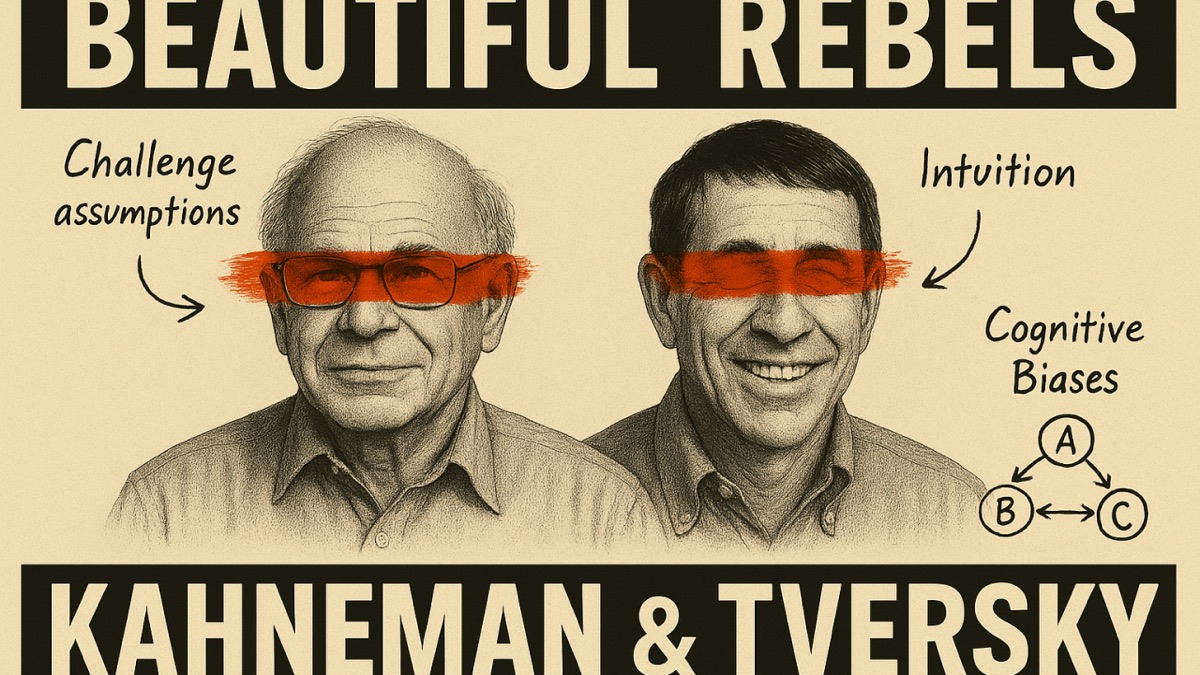
How Two Psychologists Committed Heresy Against the Church of Economics
“The sooner you realised Amos Tversky was smarter than you, the smarter you were.” — Lee Ross, Stanford psychologist and close friend
That was the one-line intelligence test.
Ross wasn’t joking. Tversky didn’t just win arguments—he blitzed them. Fast. Fearless. Mathematically immaculate.
Kahneman was the opposite. Slow. Cautious. Brilliant in bursts. He distrusted his instincts, circled every idea, and found beauty in the flaws others ignored.
Tversky brought clarity. Kahneman brought chaos. Together, they created the most powerful idea in modern decision-making: That people aren’t rational.
Not in a flaky, sometimes-we-mess-up way. In a fundamental, system-wide, your-entire-model-is-wrong kind of way.
They didn’t shout about it. They tested it. And the results cracked the foundations of an entire field.
The Church of Economics
Economics, at the time, wasn’t just confident. It was smug. It assumed people made logical, consistent decisions. Optimising their happiness. Maximising their utility. That assumption was so baked-in, so untouchable, it had become dogma.
Homo economicus was the high priest—cool, rational, always choosing wisely. Markets worked because people worked like that.
Except they didn’t.
Kahneman and Tversky saw it clearly, because they weren’t economists. They were psychologists. Outsiders. Brilliant. Blasphemous.
And they dared to ask the question no one else would:
What if the entire field is based on a completely wrong idea of how humans think?
The Evidence Was Everywhere
Their experiments looked simple. But they were surgical.
One of their most famous examples was about saving lives in a hypothetical disease outbreak.
People were offered two choices:
-
Option A: Save 200 people for sure.
Option B: A one-third chance to save all 600 people, and a two-thirds chance to save no one.
Most people played it safe. They picked Option A.
Then they flipped the wording:
-
Option A: 400 people will definitely die.
Option B: A one-third chance that no one will die, and a two-thirds chance that all 600 will die.
Same math. Same outcomes. But now, most people chose the gamble.
The only difference? The frame. When framed as lives saved, people wanted certainty. When framed as lives lost, they wanted to roll the dice.
That’s not rational. That’s human. And it wasn’t a one-off. It was everywhere.
They named these patterns:
-
Availability: We confuse what’s memorable for what’s true.
Anchoring: We get stuck on irrelevant numbers.
Representativeness: We see patterns that aren’t there.
Loss aversion: We’d rather not lose £5 than gain £10.
These weren’t random quirks. They were the architecture of human thinking. And that meant the rational-choice model wasn’t just limited. It was delusional.
Prospect Theory: The Rewrite
Their answer to all this wasn’t just critique. It was reconstruction.
Prospect Theory showed that we don’t assess outcomes logically. We compare them to a personal reference point. We overreact to small risks. We fear loss more than we value gain. We don’t act like calculators—we act like people.
It was psychology with predictive power. Messy, but accurate. Human.
And it was so undeniable that even economics couldn’t ignore it. Kahneman received the Nobel Prize in Economics in 2002—one of the few non-economists ever to win it. Tversky had died by then, or he’d have shared it. The Nobel doesn’t do posthumous awards. But everyone knew: it was their theory, their data, their rebellion.
The Gospel Falls Apart
What they did wasn’t just academic. It was theological.
They revealed that Homo economicus was a fairy tale economists told themselves to sleep at night. A myth in a suit. A model that looked clean—because it erased everything messy about human nature.
Kahneman and Tversky didn’t destroy that myth out of malice. They did it out of intellectual integrity.
They saw behind the curtain. And what they found wasn’t a machine.
It was us. Emotional. Inconsistent. Predictably irrational.
They told the Church of Economics that its god was imaginary. And here’s the beautiful irony:
The very foundation of economics—rational decision-making—turned out to be the most irrational belief of all.
They didn’t end that myth. But they made its illogic impossible to ignore.
And that’s a profoundly beautiful idea.