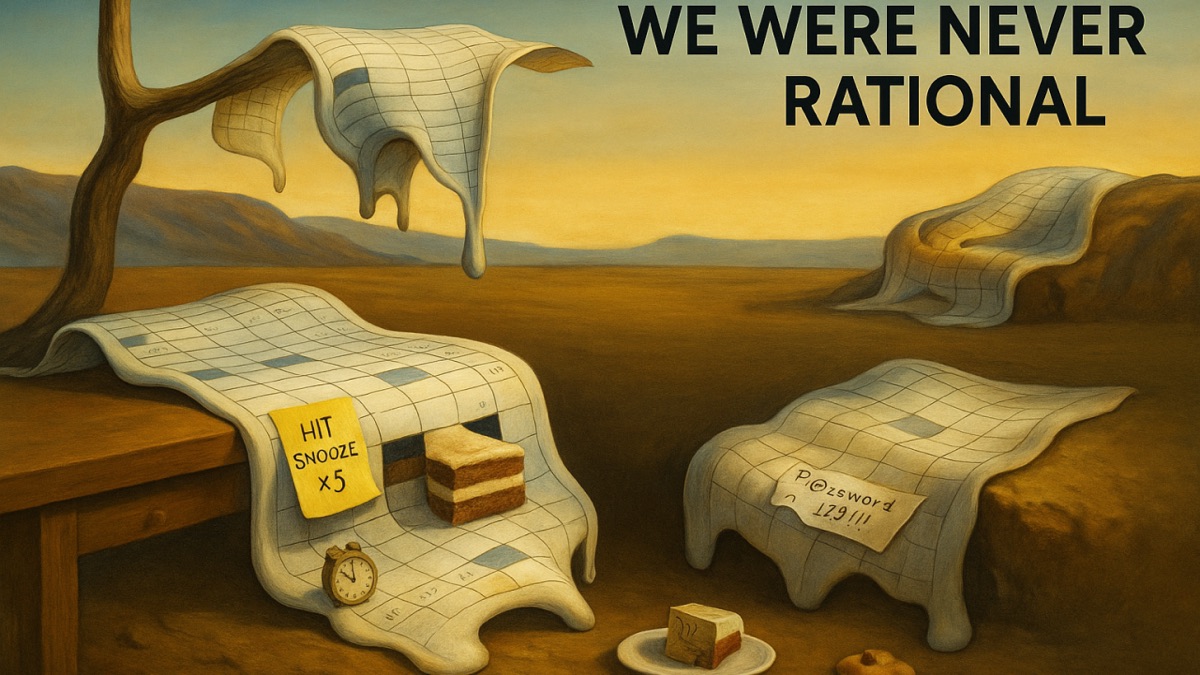
We Were Never Rational
Economists once imagined people as little spreadsheets with shoes. Rational, calculating, weighing every choice like a human Excel file. Homo economicous, or 'Econs' for short.
Then behavioural science came along and asked: “Have you actually met a human?”
We hit snooze on alarms. We forget passwords weekly. We eat cake for breakfast and then Google “how to lose belly fat” at 2am (true story...).
Nudges pulled back the curtain on that glorious irrationality.
-
Organ donation: Austria has a 99% donor rate. Germany, next door, has 12%. Same culture. Same sausages. Different tick-box.
Towel reuse: Tell hotel guests “most people do it” and suddenly we’re saving the planet one slightly damp towel at a time.
Retirement savings: Default workers into pensions, and suddenly millions are securing their futures without lifting a pen.
Richard Thaler, the godfather of nudges, put it plainly: “Humans are not Econs.”
The early wins were intoxicating. Cafeteria layouts shaped diets. Rewritten tax letters boosted compliance. Even button colours mattered.
But here’s the catch: the world is messy. What dazzled in a controlled trial fizzled in the wild. Contexts clashed, cultures differed, replication humbled us. The nudge was brilliant, but brittle.
That was behavioural science’s first act. Then came the encore.
Then AI Crashed the Party
AI didn’t sneak in politely. It crashed through the wall like the Kool-Aid Man, shouting: “Ohhh yeah!”
And here’s the kicker: we’re only just beginning to use it.
Already, the sparks are flying:
1. Simulated Audiences
In 2023, researchers showed GPT-style models could predict which nudges would work in the real world. They ran classic behavioural interventions—framing effects, defaults, norms—through LLMs fine-tuned on human data, and the model’s “choices” lined up with actual field results.
That’s insane. It means we can use AI as a behavioural wind tunnel. Run thousands of variations cheaply and fast, and only put the best into real-world flight.
(Or, to quote Morpheus in The Matrix: “Do you think that’s air you’re breathing now?”)

2. LLMs as Ideation Partners
In creativity research, large language models score around average-human levels on divergent thinking tests. Not dazzling—but tireless.
They’ll churn out 200 metaphors in seconds. Most will be bland. Some bizarre. A few brilliant.
Your role shifts from generator to curator of the weird. Imagine testing vaccination messages not just in dry prose but as Shakespearean sonnets, punk lyrics, or sitcom punchlines. Most would flop. But one could stick.
As Steve Jobs said:
“Creativity is just connecting things.”
LLMs connect more things than you ever could.
3. The Centaur Advantage
Harvard research shows “centaur” teams (human + AI) outperform both sides alone in creative and analytical work. Humans bring taste and context; AI brings scale and speed.
Daniel Kahneman once said:
“Nothing in life is as important as you think it is, while you are thinking about it.”
Humans get tunnel vision. AI gets scatterbrained. Together? Balanced brilliance.
4. Boosts at Scale
Nudges have always been accused of manipulation. The alternative is “boosts”—helping people build decision skills. AI supercharges this: micro-tutorials, adaptive coaching, bite-sized explainers in the moment of choice.
Think of it as Clippy with a PhD: “It looks like you’re about to misdose your medication. Want a 30-second refresher?”

5. Adaptive Nudges
This is the wildest shift. Old nudges were static. Defaults, forms, letters. New nudges can be living systems.
Adaptive UIs that notice you doomscrolling at 2am and nudge you to sleep instead of to shop. Pill reminders that change tone if you ignore them. Digital environments that choreograph themselves around your quirks.
And here’s the really cool implication: in the near future, you could have your own AI super-agent, tuned to your macro goals—lose weight, sleep better, spend more time with the kids, make a million dollars. Instead of a blunt time limit on Instagram, it could actively counter the apps trying to trap you, nudging you to drink water, go for a run, or even slip personalised motivation into the feed. Imagine it remixing your favourite music or generating a bespoke podcast each morning designed to keep you aligned with the life you actually want.
It’s not chaos. It’s order out of breathtaking complexity—an ability to choreograph behaviour at scale, beyond what any Nobel laureate could hold in their head.
The Double-Edged Sword
Of course, the first people to realise this weren’t doctors or educators. They were social platforms.
Your infinite scroll feed is already an AI-nudge machine—personalised defaults that keep you swiping, watching, buying. It’s behaviour change industrialised, pointed at your attention span.
That’s the dark side.
But imagine the light. Adherence to medication today hovers between 10–50%. That’s catastrophic. With AI-powered nudges? We could push it to 70, 80, 90%. Not by lecturing. By designing reminders, systems, and feedback loops that actually work for messy, irrational humans.
That’s lives saved. Billions unlocked. A genuine step-change.
What’s Next
We’re still in the tuning phase—the Hendrix-guitar-twiddle before the solo. But the trajectory is clear:
-
From tweaks to choreography: nudges won’t be isolated tricks; they’ll be adaptive systems that learn and respond.
From A/B to A-to-Infinity: instead of two versions of a message, we’ll test thousands—frames, metaphors, voices—until we find what resonates.
From insights to orchestration: behavioural science won’t just reveal quirks. It will orchestrate them at cultural scale.
That’s not button colours. That’s symphonies.
So Where Does This Leave Us?
The story is simple:
-
Nudges showed us we’re irrational.
AI lets us navigate that irrationality at scale.
The future is orchestrating behaviour in ways that could save lives—or wreck them, depending on who’s holding the reins.
Or, to channel Bowie: “Turn and face the strange.”
Because the strange is here. And it’s not chaos. It’s order—beautiful, terrifying order—at a scale we’ve never seen before.
The question isn’t if we’ll use it. The question is: what for?