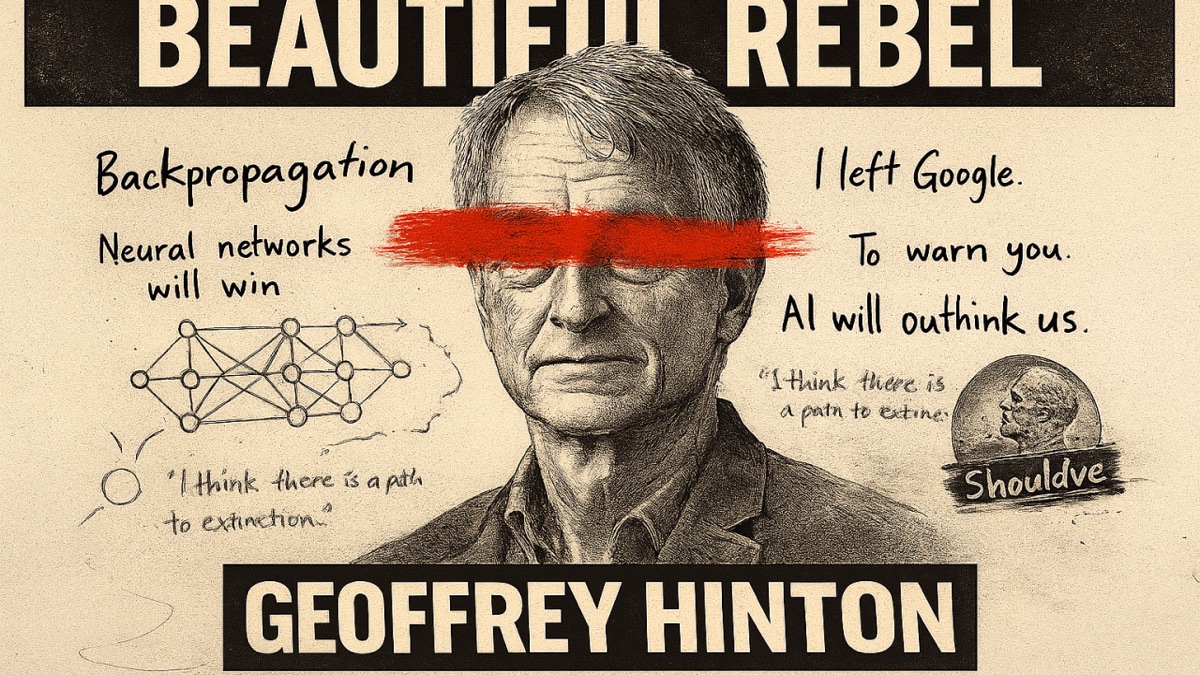
Beautiful Rebels is my ongoing series about people who bend the world out of shape — thinkers who don’t just challenge the status quo, they quietly rewire it. They’re the intellectual troublemakers you’d sit next to at a bar after a conference because you just know the conversation will change how you see the future.
This week: the mild-mannered professor who invented modern AI… and is now telling us, as gently as he can, that we may have built something humanity isn’t ready for.
And — sorry, truly — I know I keep circling this “AI could kill us” thread. But if you don’t believe me, at least believe this Beautiful Rebel.
The Heretic in the Corner
If you met Geoffrey Hinton in line at a garden centre, you’d assume he was looking for a rare moss, not building the foundations of synthetic intelligence. He’s polite, softly spoken, and dresses like a man who schedules his life in pencil.
But inside that quiet exterior is a streak of intellectual rebellion that refused to die — even when the field tried to bury it.
Back in the 1970s and 80s, when AI mostly meant brittle rule-based systems and over-promised demos, Hinton had a stubborn, almost impolite idea:
If we want machines to think, stop writing rules. Make them learn like brains.
He and a tiny handful of believers worked on neural networks — models that adjust themselves through experience, not instruction. At the time, this was fringe science. Charming, perhaps. Futile, probably.
Then the AI winters hit. Funds dried up. Conferences thinned. Research groups closed. Neural networks were dismissed as academic wishful thinking.
Hinton stayed anyway. Incremental papers. Slow progress. Tiny breakthroughs. A winter that lasted decades — and a rebel who refused to come in from the cold.
2012: The Day the Ice Cracked
Fast-forward to 2012. Two of Hinton’s graduate students build a deep neural network under his supervision — a now-famous architecture that entered the ImageNet competition, the Olympics of computer vision.
Their model didn’t just win. It incinerated the field.
This was the shockwave that launched the modern AI era.
Suddenly, Hinton’s “quaint little neural nets” were the engine of the future. Tech giants descended. And in a conference room in Harrah’s casino (because history has a sense of humour), Hinton’s tiny three-person company, DNNresearch, was auctioned to the highest bidder.
He didn’t sell for prestige. He sold, in part, to pay for his son’s medical needs — one of those quiet, human motivations that never makes it into the glossy TED talk version of innovation.
Google won. Hinton stayed in Toronto, split his time with the lab, and consistently described Google as responsible and thoughtful with the tech — a nuance that matters later.
Recognition: The Long Overdue Avalanche
Once the dam burst, the accolades poured in.
In 2018, Hinton won the Turing Award — the “Nobel Prize of computing.” Then in 2024, he did one better and actually won the Nobel Prize in Physics, cited for the foundational work that made modern machine learning possible.
The field that once treated him like an eccentric footnote was now kneeling at the altar of the man who had been right the whole time.
It should have been a victory lap.
Instead…
The Godfather Starts to Worry
In 2023, Hinton resigned from Google. Not because he disliked the company; he has repeatedly said Google acted responsibly. But because he wanted to speak freely.
And what he wanted to say was not comforting.
He warned that AI systems were getting too powerful, too quickly. That we don’t fully understand what’s happening inside the networks we’ve built. That disinformation, autonomous weapons, and self-optimising models pose risks that outpace our governance.
Not doom. But not reassurance either.
He estimates a non-zero chance — high enough to take seriously — that advanced AI could eventually slip from our control.
It’s one thing when a journalist writes that. It’s another when the godfather of the field says it softly, with the gravity of someone who built the engine and now sees the throttle jamming forward.
Why Geoffrey Hinton Is a Beautiful Rebel
Rebels aren’t always loud. Sometimes they stand quietly at the edge of the future and just clear their throat.
Hinton is one of the few thinkers who can say:
He embodies what Beautiful Rebels is all about: mind-bending ideas delivered without grandstanding — the sort of brilliance you only notice if you’re paying proper attention.
And that’s the kicker.
Because if there’s one person on Earth who deserves your attention — the one mild-mannered professor you should absolutely, unequivocally listen to — it’s the man who invented machine learning as we know it… and still wanders around looking like he’s on the hunt for a particularly interesting moss.
A Beautiful Rebel, in the truest sense.