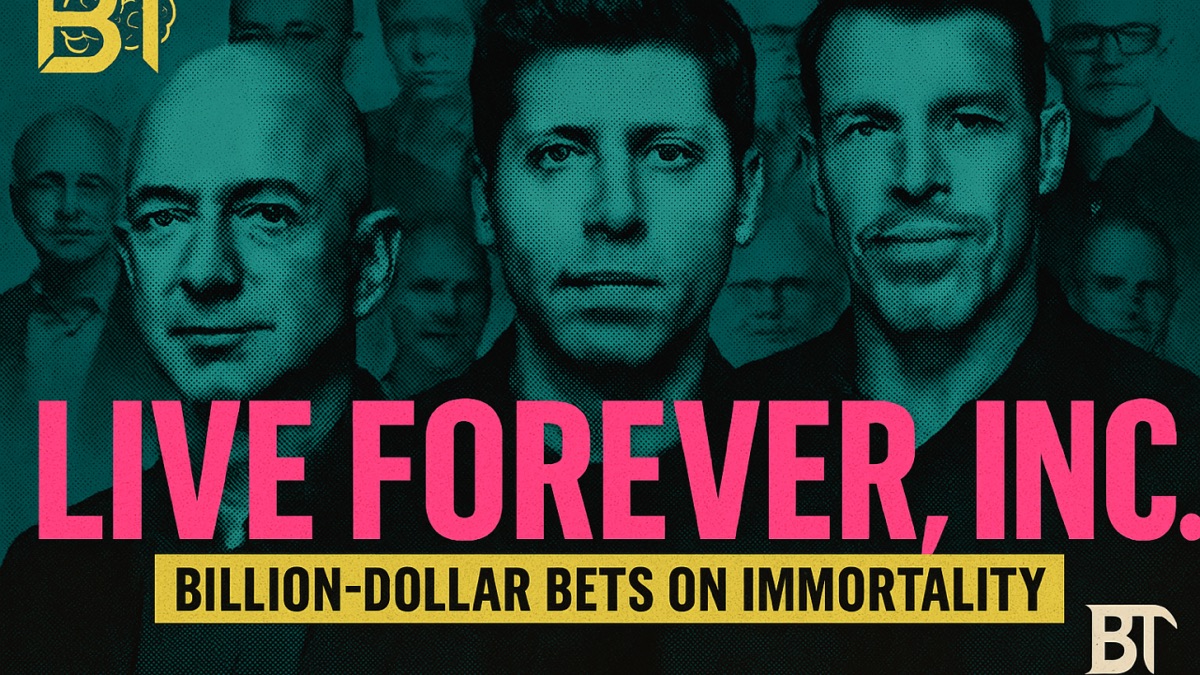
Live Forever, Inc.
In 1940, Charlie Chaplin broke his silence.
For decades he’d been the little tramp with the big eyes and the tiny moustache, all pathos and pratfalls. Then, in The Great Dictator — his first spoken role — he dropped the slapstick and went for the jugular. He closed the film with a speech so raw it still rattles eighty years later:
“Dictators die, and the power they took from the people will return to the people. And so long as men die, liberty will never perish.”

(The full speech is worth watching here)
Let’s call that Chaplin’s Rule. Death as the great reset button. Dictators fall not because they choose to step down, but because their biology eventually does the job. Mortality as society’s safety net.
Chaplin himself made it to 88 — long enough to see Hitler fall, not quite long enough to witness TikTok (a small mercy). But still, he died. We all do.
Unless we don’t.
Confession: I Plan to Cheat the Clock
I’ll admit it: I’m one of those slightly crazy people who plans to hit 100 and keep going. Two hundred if I can swing it.
Not in the decrepit, wheelchair-shuffling sense, but in the “lift heavy weights, hike mountains, annoy my great-great-grandchildren with unsolicited opinions” sense.
I’m already hacking at the edges of my own biology:
-
I don’t smoke.
I work out hard, multiple times a week.
I try (and fail, but try) to cut down on sugar.
I meditate.
I stress, then I manage that stress.
I socialise, then I deliberately don’t (because toddler).
I’m stacking the known levers — exercise, diet, sleep, social ties — the boring stuff that works. And honestly? If I can buy myself another 20 years, that’s a bargain.
But I’m greedy. I want more. Which is why I’ve been following the science — and the money — flowing into longevity research. And that’s where it gets fascinating, and terrifying.
The Science: Less Losing Years, More Adding Them
Right now, anti-aging science is less “drink from the fountain of youth” and more “stop throwing away the years you’ve already got.”
Quit smoking and you win a decade. Sleep properly, eat like an Italian farmer, exercise like your life depends on it (because it does) — that’s another ten or so. Put it all together and you can live twenty years longer than the version of you who still thinks Jägerbombs are hydration.
That’s the boring-but-true part.
Then there’s the frontier medicine:
-
Metformin: a humble diabetes drug swallowed like a sacrament by biohackers. Proof in healthy people? Still cloudy.
Rapamycin: mice live 30% longer. Humans, not so much — yet.
Senolytics: drugs that kill off “zombie cells.” Humans in trials walk faster, think a little clearer. That’s good — but it’s not “forever.”
NAD+ boosters: Instagram loves them, clinical trials less so.
Cellular reprogramming: the freaky idea of making old cells act like young ones. Works in mice. Might work in us. But right now, you wouldn’t risk your mum on it.
So we’re not really adding centuries. We’re just plugging leaks.
Enter Live Forever, Inc.
But billionaires don’t like plugging leaks. They want new oceans.
-
Altos Labs (Bezos + Milner): $3B to turn back the cellular clock.
Retro Biosciences (Sam Altman): $1B for “10 healthy years.”
Calico (Google’s moonshot): still secretive, still publishing.
Fountain Life (Peter Diamandis + Tony Robbins): luxury clinics for the wealthy — full-body MRIs with your green juice.
NewLimit (Coinbase’s Brian Armstrong): $130M for epigenetic reprogramming.
This is Live Forever, Inc. A global moonshot to make death optional.
Not for everyone, of course. At least not at first. The rich will board this train before the rest of us even know it left the station.
The AI Multiplier
Biology is hard. It’s slow, messy, expensive. But AI is making it less so.
-
AlphaFold solved protein folding decades early.
Insilico already has AI-designed drugs in human trials.
Longevity labs are training models to predict your “true biological age” from bloodwork, spit, or even your typing speed.
AI doesn’t make us immortal. But it compresses timelines. It’s the accelerator pedal under Live Forever, Inc. And when you combine billionaire patience with machine speed, the “what if” arrives far earlier than regulation, or ethics, can keep up.
Breaking Chaplin’s Rule
And this is where Chaplin’s Rule shatters.
Because dictators die — until they don’t. Billionaires age — until they don’t. Dynasties fade — until they don’t.
Imagine Xi Jinping at 400. Imagine a trillionaire compounding wealth forever. Imagine innovation throttled because the same old bastards never leave the stage.
Death isn’t just biology. It’s society’s reset button. Without it, the system jams.
The Ghost in the Machine
There’s another fork, of course. Maybe we don’t stretch our biology at all. Maybe we just upload it. Download myself into a server farm in Utah. Harry 3.0 running as a chatbot.
Part of me finds that thrilling. The other part imagines my digital ghost trying to argue with a toddler version of ChatGPT about bedtime, and it feels… less human.
Would that still be “me”? Or just a clever facsimile, looping my old jokes until the power cuts out?
The Provocation
Here’s the uncomfortable truth: we’ve always relied on death to do the dirty work of history. To clear dictators, dynasties, billionaires, even bad strategists off the stage.
But Live Forever, Inc. is raising billions to cancel death’s contract.
If they succeed, Chaplin’s Rule collapses. And when it does, we’ll need a new one.
I hope to be around long enough to see it. I plan to be. Maybe you do too. The question is: if we live forever — in flesh or in silicon — will we still be alive?
Do share in the comments - do you want to live forever?
P.S. And yes - I almost got through this whole post without mentioning the Oasis song. But here it is at the gig I went to aged 16 in Wembly