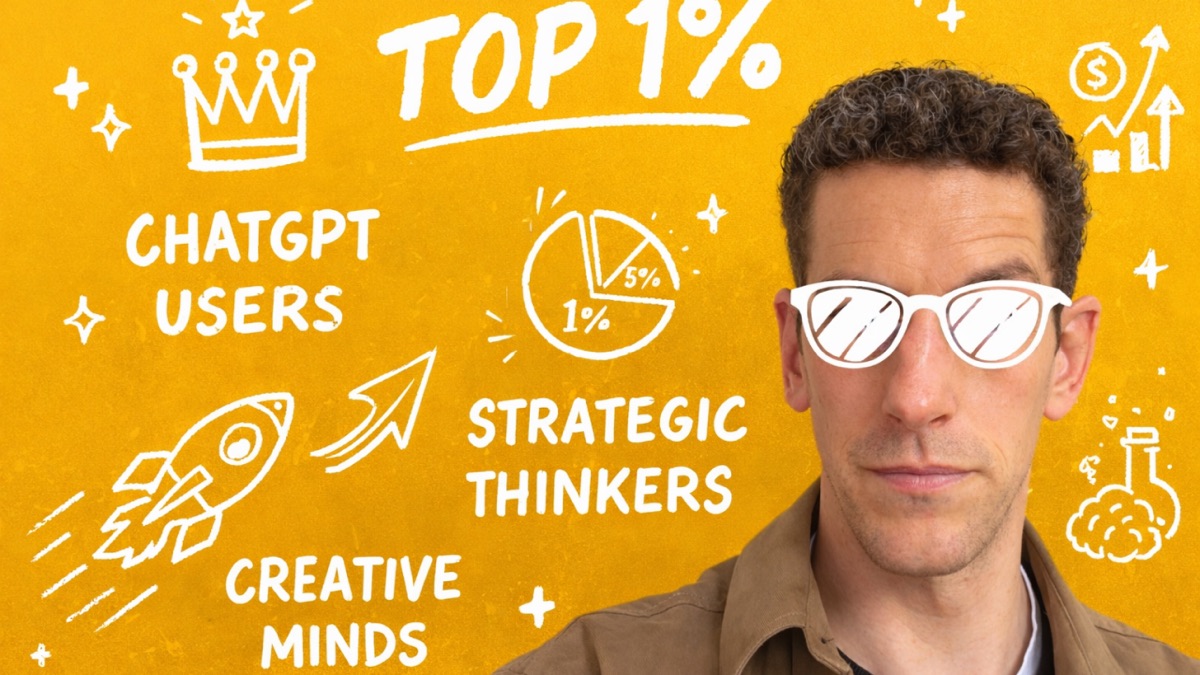
According to OpenAI’s own usage metrics, I landed in the top 1% of ChatGPT users by volume.

I still haven’t decided how I feel about that.
On a good day, it sounds like curiosity. On a bad day, it sounds like I spent 2025 talking to a machine more than is socially optimal.
But if the statistic means anything at all, it probably means this: I was keen to learn. And willing to change how I worked.
Because one thing became clear very quickly last year:
You don’t understand this technology by adopting it. You understand it by working with it until it changes you back.
2025: The year of the co-thinker
Looking back from 2026, last year now feels oddly… polite.
2025 was the year most of us learned how to think alongside machines.
We used LLMs to draft emails we didn’t want to write. To escape blank pages. To pressure-test half-formed ideas before inflicting them on colleagues.
And that pattern isn’t just anecdotal.
Across multiple large studies in 2024–2025, around 70–80% of generative-AI use sat squarely in individual productivity tasks: writing, summarising, ideation, research support.
-
McKinsey’s State of AI reports show the dominant GenAI use cases remain content generation, knowledge work, and cognitive support (McKinsey, 2024–2025).
Microsoft’s Work Trend Index found the most common Copilot activities were email drafting, document creation, and meeting preparation (Microsoft, 2024).
OpenAI’s own analysis of 1.5 million ChatGPT sessions confirms that writing and information support dominate real-world use (OpenAI, 2024).
In short: We let AI think. We didn’t let it do.
Which makes sense. Thinking alongside a machine doesn’t threaten your identity. You’re still the one “doing the work.” The AI is just helping you sound sharper, faster, slightly less tired.
The co-thinker era was useful. Clever. And psychologically safe.
The great illusion of “AI adoption”
Here’s the awkward truth that settled in by late 2025.
Most GenAI adoption didn’t actually change the work. It changed the finish on the work.
Same meetings. Same approval chains. Same bottlenecks.
Just better-written documents describing why nothing could move faster.
This is why so many pilots stalled.
Not because the technology wasn’t ready. In fact, 88% of organisations now report using AI in at least one business function (McKinsey, 2025), and 91% say they’re using generative AI tools in some form (SEO Sherpa survey, 2025).
The problem wasn’t capability. It was psychology.
People don’t resist tools. They resist losing control, status, and the comforting story that this bit of work only exists because of me.
2026: The year of the co-doer
It’s now 2026, and the question has shifted.
It’s no longer “What can AI help me think about?” It’s “What am I willing to let it do without me hovering?”
This is the move from co-thinker to co-doer.
Not sci-fi autonomy. Not rogue agents booking flights to places you hate.
Something quieter. More dangerous.
Agents that monitor systems. Make small decisions continuously. Escalate only when human judgment is genuinely required.
And we’re starting to see early evidence of what happens when organisations cross that line.
McKinsey reports that 23% of organisations are now scaling AI agents across multiple functions, with a further 39% actively experimenting (McKinsey, 2025). Still a minority — but a growing one.
Where teams redesign workflows around AI (rather than bolting it on), internal studies and case reports show 20–40% reductions in cycle time in specific areas like content operations, analytics prep, and internal research.
Not everywhere. Not magically. But enough to make old processes feel suddenly… heavy.
Crucially, the constraint isn’t the models.
It’s trust.
Why delegation feels harder than thinking
This was the most important lesson of 2025 for me.
Adoption is easy. Delegation is hard.
Thinking alongside a machine feels collaborative. Letting it act on your behalf feels intimate — almost invasive.
Because it forces questions we’ve spent years politely avoiding:
What am I actually responsible for? What do I oversee rather than execute? If the system can do that, what exactly is my role?
And this isn’t theoretical.
Gallup data shows that while 23% of U.S. employees now use AI several times a week, and 10% use it daily, far fewer are comfortable trusting AI with decisions or autonomous action (Gallup / Business Insider, 2025).
Most people who struggled with GenAI last year weren’t struggling with prompts.
They were struggling with identity.
The real bottleneck in 2026 isn’t AI
So here’s the unfashionable prediction.
In 2026, AI will not be what holds most organisations back.
Human psychology will.
Our attachment to tasks that signal value. Our discomfort with invisible work. Our tendency to confuse effort with importance.
Most agentic AI initiatives won’t fail because the technology isn’t ready.
They’ll fail because:
-
ownership is unclear
accountability is fuzzy
escalation rules are vague
automation is confused with abdication
Delegation without design is just chaos with a GPU.
The teams that succeed will be boring about it. Clear scopes. Clear hand-offs. Clear responsibility. Less magic. More maturity.
A final thought
If being in the top 1% of users means anything at all, I hope it’s this:
I was curious enough to play. Awkward enough to learn. And willing to let my work — and my sense of self — change.
2025 taught us how to think with machines. 2026 will test whether we’re ready to work with them.
Same technology. Different relationship.
And this time, the thing most likely to slow us down won’t be AI.
It’ll be us.
References (for the sceptically inclined)
-
McKinsey (2024–2025) – The State of AI
Microsoft (2024) – Work Trend Index
OpenAI (2024) – How People Are Using ChatGPT
SEO Sherpa (2025) – Generative AI Adoption Survey
Gallup / Business Insider (2025) – Workplace AI Usage Poll