I’ve been fairly vocal about AI and jobs.
Alright, more than fairly. I’ve been one of those people at the bar, leaning in too hard over a pint and saying, “Have you lot realised what this means?” I’ve worried, loudly, about what happens when machines stop just helping humans think and start doing large chunks of white-collar work better, faster, and without needing a coffee, a manager, or a nervous little cry in the stairwell.
And after doing a lot more research on it, I don’t think the fear was silly.
But I do think I made the argument too simple.
Because the more I read, the less the evidence said, “AI replaces jobs,” and the more it said something stranger, messier, and much more useful:
AI replaces tasks.
That sounds like a technical distinction. It isn’t. I think it’s the whole bloody story.
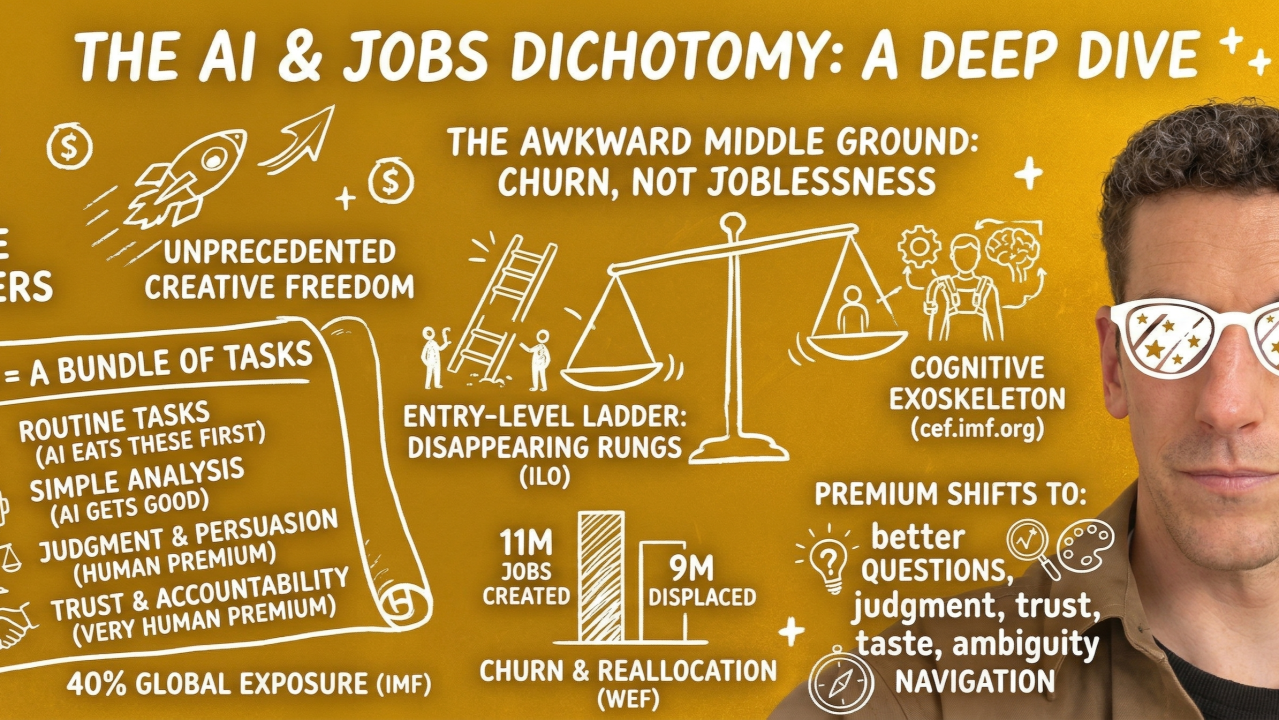
A job is really just a bundle of tasks wearing a nice shirt. Some of those tasks are repetitive, procedural, and painfully easy to define. Others are murkier: judgment, persuasion, taste, politics, trust, reassurance, knowing when the obvious answer is actually stupid. AI is getting frighteningly good at the first category, surprisingly decent at parts of the second, and still quite patchy once the world gets genuinely human and inconvenient. That matters, because once you stop treating jobs as indivisible lumps and start seeing them as bundles of tasks, the whole labour-market picture changes shape. (IMF)
That was the first thing that made me pause.
The second was this: exposure is real, and it is big. The IMF estimates that nearly 40% of global employment is exposed to AI, with the figure rising to around 60% in advanced economies. The ILO’s updated 2025 work reaches a similarly serious conclusion, while stressing something important: for most occupations, generative AI is more likely to transform jobs than automate them away entirely. In other words, yes, the wave is real. No, it does not automatically mean half the office gets fired by Thursday. (IMF)
That’s a more awkward story. Which is probably why fewer people tell it.
Because “mass unemployment” is clean. It has drama. It has headlines. “Things will be re-bundled unevenly across tasks, firms, sectors and time horizons” is, admittedly, less sexy. It also happens to be closer to the truth.
Anthropic’s recent labour-market work is useful here. Their early evidence finds limited signs, so far, of a clean unemployment shock from AI. That does not mean AI is harmless. It means the impact is showing up in more subtle ways first: slower diffusion than the hype implies, uneven adoption, and hints that younger workers may be getting squeezed in more exposed roles before we see some giant Hollywood layoff montage. That feels plausible to me. The front door narrows before the whole building falls down. (Anthropic)
And if you’ve spent any time watching junior white-collar work lately, that should ring alarm bells.
Because entry-level jobs are often made up of exactly the stuff AI is annoyingly good at: first-pass research, basic analysis, summarising, formatting, drafting, deck-building, synthesis, support work, all the invisible glue work that used to be how you learned the ropes. If the machine starts doing the rope-learning bits, you don’t just have a productivity story. You have a ladder story. And ladders matter. Whole professions quietly depend on years of slightly crappy, semi-repetitive early work turning you into someone useful. If AI eats too much of that layer too fast, the danger is not simply unemployment. It is a world in which the path into expertise starts disappearing rung by rung. (International Labour Organization)
But this is where I had to stop being quite so gleefully apocalyptic, because there is real evidence on the other side too.
One of the strongest field studies we have found that generative AI lifted productivity among customer-support agents by around 15%, with the biggest gains going to less experienced and lower-performing workers. That is not a rounding error. That is not a keynote speaker in expensive trainers saying “the future is now.” That is a meaningful shift in what one worker can do with machine assistance. It suggests that some of what AI does is not simple replacement. Some of it is augmentation. Some of it is leverage. Some of it is a kind of cognitive exoskeleton for ordinary workers. (cef.imf.org)
And once you accept that, the whole debate gets less tidy.
Because now the question isn’t “Will AI destroy jobs?” versus “Will AI create new ones?” Both of those are too blunt, and both let people smuggle in assumptions. The real question is whether the new value created by AI arrives fast enough, and spreads widely enough, to offset the disruption it creates in the meantime.
That’s a harder question. And, annoyingly, a more interesting one.
The optimists have some evidence. The World Economic Forum’s 2025 report suggests AI and information-processing technologies could create around 11 million jobs while displacing 9 million by 2030. That is not utopia, but it is not jobless wasteland either. It is churn. It is reallocation. It is one set of doors closing while another set gets built in the room next door, ideally before too many people end up sitting on the floor wondering what happened. (World Economic Forum)
The problem is that time does a lot of work in those sentences.
History’s comforting line is that new technologies usually create new industries and jobs. Fair enough. The trouble is that history often does this over decades, while AI is moving at a speed that makes most institutions look like they’re trying to outrun a motorbike in Crocs. If the optimistic case is right in the long run, that still does not spare people from a very ugly middle. The transition itself can be brutal even if the destination ends up broadly positive. (World Economic Forum)
And that ugly middle is, I think, what I’d underplayed.
Because AI is not just changing labour. It is exposing organisational nonsense. Duplication. Handoffs. Bureaucratic drag. Tasks that existed only because information was hard to move, hard to compare, hard to summarise, hard to coordinate. Once cheap intelligence arrives, a lot of old corporate architecture suddenly looks like a very expensive tribute act.
That is why the story now feels bigger than “Will the bot take Susan’s job in accounts?”
AI changes the economics of tasks. That changes the economics of teams. Then functions. Then firms. Then industries.
So yes, I still think some people are right to be nervous. Very nervous, in some cases. If your role is made largely of repeatable cognitive tasks, and especially if it sits near the bottom of a professional ladder, I would not soothe yourself with lazy historical analogies and a wellness webinar. But I also don’t think “AI will leave us all unemployed” is the cleanest or smartest description of what is happening anymore.
It is doing something subtler than that.
It is making execution cheaper.
And once execution gets cheap, the premium shifts elsewhere.
Toward judgment. Toward trust. Toward taste. Toward accountability. Toward the ability to ask better questions, not just produce faster answers. Toward navigating ambiguity when the machine has produced five plausible options and someone still has to decide which one won’t blow up the client, the patient, the brand, or the business.
That doesn’t mean humans become magically safe. It means the definition of valuable human work starts moving under our feet.
Which is why I think I made the job-pocalypse too simple.
The problem isn’t just that AI might replace jobs.
It’s that AI starts by replacing pieces of jobs — and when enough pieces go, the job quietly becomes something else.
Sometimes better. Sometimes smaller. Sometimes more strategic. Sometimes more precarious. Sometimes more valuable. Sometimes dead, but still hanging around under the old title out of politeness.
So the real question, I think, is not: Will AI leave us all unemployed?
Not exactly.
It’s this:
What parts of your job are still worth paying for once execution gets cheap?
That is a far more uncomfortable question.
Which is probably why it’s the one we should be asking.