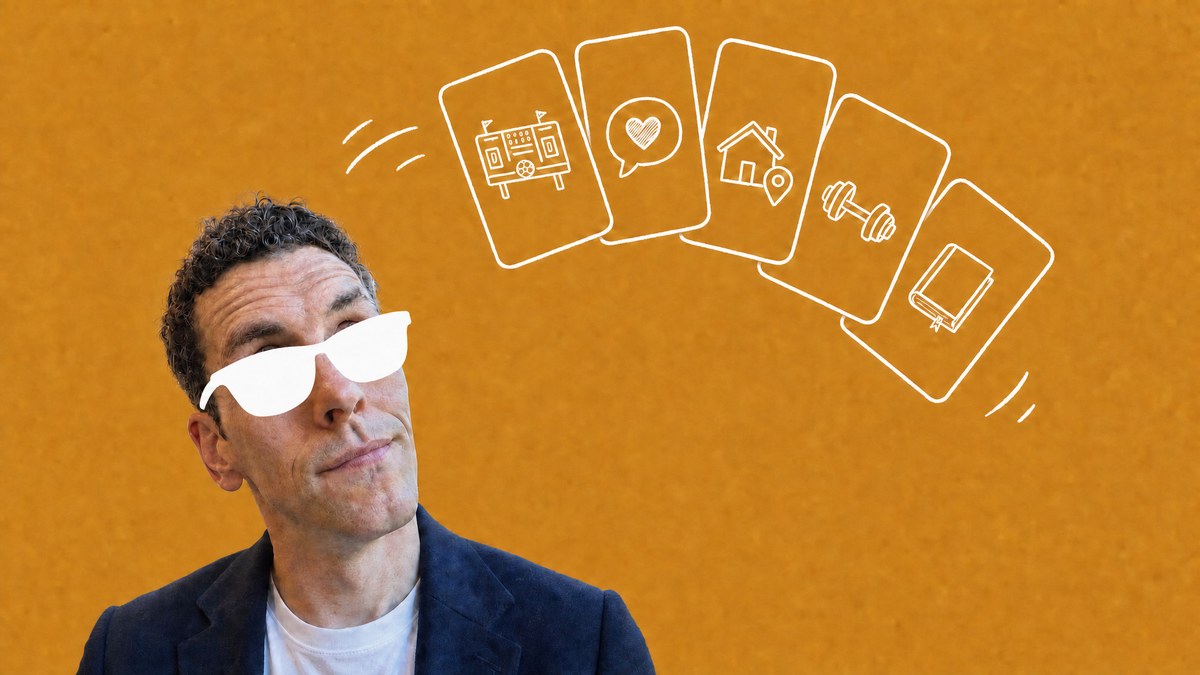
I've never really struggled for ideas — small ones, ambitious ones, all of it — and I'm genuinely good at thinking them through properly: research, structure, working out how the thing should actually behave. What I've never had is a reliable way of getting from that fully-formed idea to something real) beyond a meticulous and beautiful PowerPoint deck!). A working business. A finished book. An app someone could actually open and use. That gap has sat there for most of my life, and it was never really in my control.
I have history with this specific kind of stuck. When the App Store first appeared and they said there was an app for everything, I bought the book on how to build iPhone apps. Got about a third of the way through before realising building software myself was never going to happen, and put it down. The ideas were fine — I still have the notebook, twenty of them, each one properly thought through. What I didn't have was any way of actually shipping one.
There's been the side-hustle version of this too — mornings and evenings, carved out around the day job. I've listened to more of those "how I built the next big thing" podcasts than I'd like to admit. None of this was ever a thinking problem: the methodologies behind my half-written books were researched and built out properly, the same rigour I'd bring to any client project, and I genuinely like the actual writing — I'm not just someone dragging myself up at 5am, though I've done plenty of that too. I've talked my wife into a Sunday of me disappearing to a coffee shop with a manuscript instead of doing the DIY more than once. It was always enough to keep something moving in snippets. It was never enough to lock myself away and finish the whole thing in one go. Then there's a startup I still haven't really talked about publicly, which fell apart for a blunter reason: we ran out of runway before we ever got close to shipping.
So why is now different? Because the ideas never needed any more work — I still have every one of them — but I can finally build them myself. I remember pitching a couple of those ideas around, hoping to find a CTO friend who'd build me even just a basic website. These days I don't need to go looking. I've got my CTO friend. Their name's Claude.
What's changed is that I can now run them all the way out, sometimes further than makes sense. The mildly embarrassing result is that, without ever deciding to, I've ended up with at least five separate draft businesses - created in the last 4 months. Not because I got more ambitious — I just stopped being stuck at the same point every time.
The mechanism matters more than the list, so let me start there.
For most of history, an idea didn't die because it was bad. It died because chasing it past the daydream stage cost too much, so you didn't bother. You had the idea, felt the little spark, and watched the effort required quietly put it out. We called that focus. Sensible, even.
AI collapsed that cost. The distance between "wouldn't it be good if…" and a working version is now an afternoon rather than a quarter. What I didn't expect is that when trying gets that cheap, you don't just finish the ideas you'd have abandoned — you push them further than you'd ever have justified before, because building the absurd, over-the-top version costs about the same as building the sensible one.
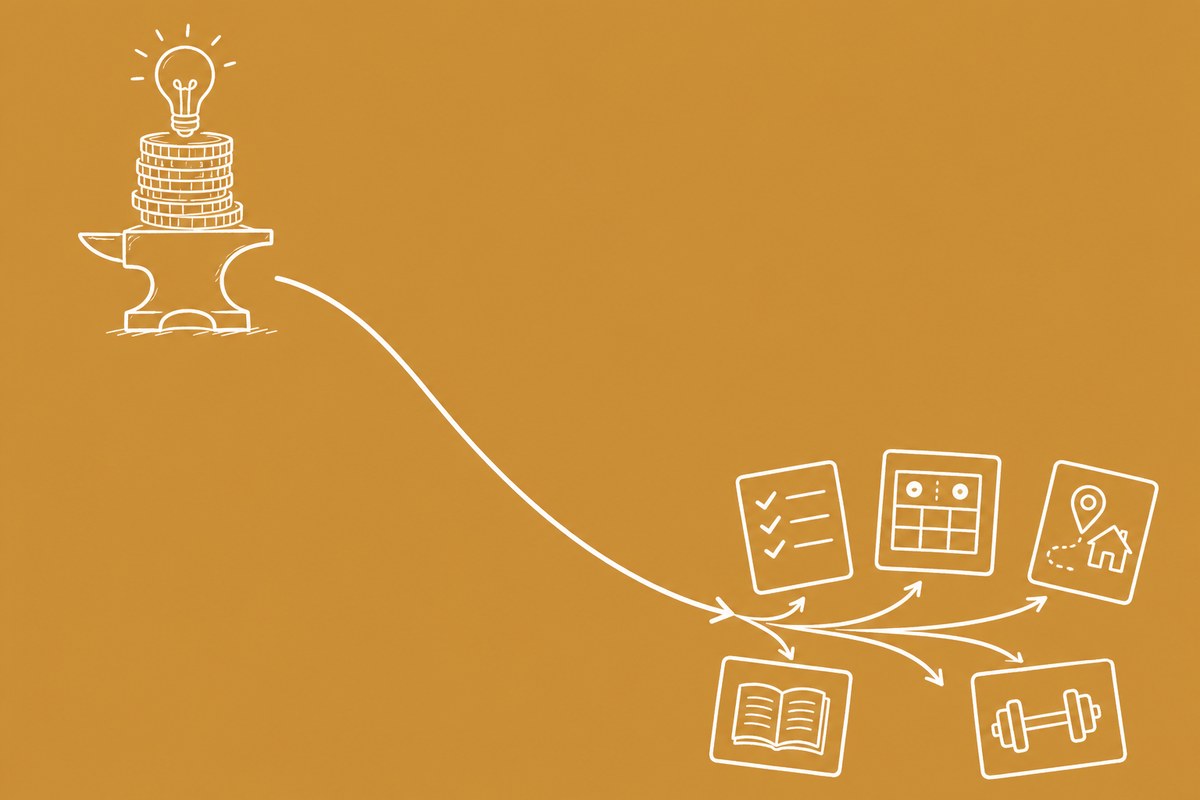
Probably easiest if I just show you what I mean by "too far."
There's Alongside. I'd had the idea for years — a way of having the stats and facts that the commentators have access to for my own viewing whilst watching a match — and it just sat there. Now it's built, and not just for one sport - Football, F1, Golf and Rugby Union; and I can just build it out further for every major sport that throws off enough data. I didn't build the small version. I built the one I'd never have justified the hours for.
Then there's GroundTruth - a postcode checker I built because a friend was buying a house and quietly getting stitched up by everything the estate agent had no reason to mention: rights of access, flight paths, the noise you only discover once you've moved in. It took one afternoon, and now there's a free tool that maps the things nobody tells you. It might be nothing. It cost me an evening to find out.
There's also The AI Habit, which grew out of a question a hundred people kept asking me — what do I actually do about all this? And it now has dozens of subscribers and real paying users. And there's Sven, a training tool I built for myself ahead of a Hyrox season, that ended up quietly living in other people's pockets too - being the best nutrition and PT 'app' that I've ever had.
And then there's the one I took furthest of all.
For ten years I've had a scenario-planning method — a way of writing strategy that survives a future you can't predict — built originally for the big pharmaceutical brands I've worked with. Five years ago I started turning it into a book. I got about seventy per cent of the way in and stalled, the way you do.
AI didn't just help me finish that book. It let me take it further than I had hoped possible.
It turns out the same method wants to point at more than one future — a career in the age of AI, a body that rewrites its own plans hour to hour, a training week. So instead of one stalled manuscript, there are now four books being written in parallel, each aiming that one method at a different part of life, with a whole ecosystem forming around it. That's not something one person could have pulled off five years ago; I'd have had to pick one and let the rest die as good intentions. These are the forthcoming Tomorrow books — more on those soon.
SO, why am I telling you all this?!
None of these is a company yet. I still call them draft businesses, because that's honestly what they are: real, working, used-by-actual-people things that haven't been asked to decide what they want to be. My AI due-diligence agent has been through all five with zero flattery, and remains, let's say, measured.
But the interesting part isn't the hustle.
I didn't set out to pursue five things — I didn't really choose anything. I just kept having the ideas I've always had, except this time the cost of chasing them dropped low enough that I stopped talking myself out of it. Each one is a small bet: cheap to place, cheap to be wrong about, survivable if it comes to nothing, and occasionally a real thing people want.
Which more or less overturns the one piece of advice I'd have given my younger self with total confidence — focus, pick one, don't get distracted.
That advice was right when trying was expensive, when every extra bet cost you the one you'd already committed to. I'm not sure it holds the same way anymore. When you can take ten ideas to their extreme for what it used to cost to half-finish one, holding all your attention on a single bet stops looking like discipline and starts looking a bit like leaving nine good options on the shelf for no reason.
So I've stopped rationing. I place a lot of small bets now and let the world decide which ones matter, rather than trusting my own judgment — which, if I'm honest, is the input I trust least in this whole process.
Five draft businesses, none of them planned. Turns out that isn't a lack of focus. It's just what optionality looks like once the price of trying finally hits the floor.