(Originally written for the Strategic North Blog - http://www.strategicnorth.com/blog/healthcares-imminent-data-revolution/)

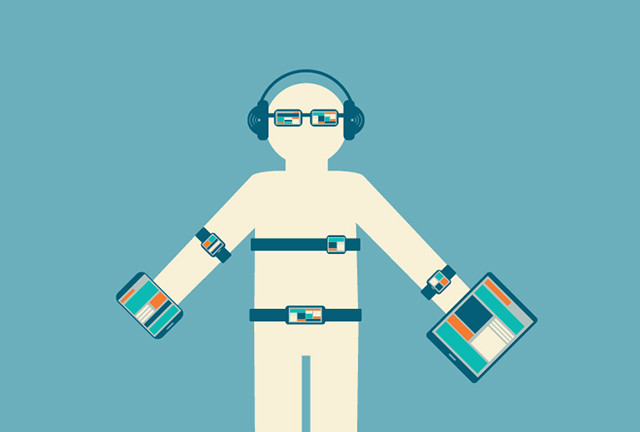
I have recently become increasingly fascinated by the rise in popularity of wearable activity monitors and their implications. Of course activity monitors are not new; the pedometer was invented in 1790 by the Swiss watchmaker Abraham-Louis Perrelet (the mechanism of walking used to self-wind the watch). However, in the modern age during the last 5 years, wearable activity and fitness monitors have become big business.
The reason these are so interesting to me, is their link to smartphones and their generation of health related data.
Typically these devices will monitor steps and movement, usually resulting in a daily ‘calorie burned’ figure. You can then add the food you have consumed that day into the associated smartphone app – and together they give you a calories in-out equation. Simple.
Ok, perhaps dietary and activity tracking are not particularly exciting – aside from taking the guess work out of people wanting to loose or gain weight – but this is only the beginning. The biggest impact is on behavioural change and behavioural recommendations that the app can make. There are now features within apps that will take your data and provide you with advice, like ‘eat more daily fibre’ or ‘reduce your saturated fat intake’. Some of the activity monitors have even advanced beyond that too, with wearable sensors that monitor and aid sleep, and some which measure your pulse rate and blood pressure throughout the day.
Just with that data alone there is a wealth of possibilities for what this could mean for an individuals’ health, and the recommendations the app (or at least the algorithm designed within the app) could make. For example, your app could see that you treated yourself to an afternoon chocolate bar, this caused your activity to spike and slump, and during your slump your blood pressure was raised as you became stressed because the lethargy meant you weren’t finishing tasks quickly enough, which lead to you leaving work late, increasing blood pressure further throughout your evening and leading to poor sleep patterns that night. The app’s advice is to try a slow-release snack at 3pm tomorrow instead!
What amazes most people is that the above example is possible with technology available now – and a bit of smart algorithm mapping (and probably a less simplistic cause-and-effect interpretation!). But now imagine what could be done in the next 5-10 years.

A European based consortium of universities and companies called Smartext, have been working on textiles that have embedded sensors that remotely monitor the body. Their aim is that these fabrics will be able to provide monitoring of vital signs, metabolic disorders and early warnings of health risks. Advances in wearable technology, mean that sensing biological changes will soon be very easy, and the ‘norm’. The natural second stage will be the interpretation and analysis of this vast amount of data, for useable (and friendly) information and advice. Luckily (nearly) all of us carry around a powerful computer in our pockets suitable for exactly this purpose.
These advances in technology over the next few years, and their implications, bring to mind one significant interaction that will be impacted greatly – that of the patient and their HCP. Having personally heard diabetes nurses complain that they don’t like the electronic graphs produced by new blood glucose meters, preferring instead their old system of eye-balling patient hand-written HbA1C readings in a notebook, you wonder how will HCPs cope with this data-influx? Additionally, as the data points increase in number and complexity, it will become much more important for HCPs to be able to read and interpret data – that is more complex than their usual clinical-paper based basic understanding. Are clinics and hospitals then going to need to employ statisticians alongside their lab technicians to help with this? Are universities teaching these new skills to medical students, most of who will have grown up with a smartphone in hand?
In my eyes the rise in health monitoring data is a great thing, and will mean healthcare decisions are based more on measurable fact and probability outcome measures, and less on ‘feeling’ and sensibilities of that particular HCP or patient on that day. However, is the healthcare system ready to deal with this information influx, or will it stick doggedly to the old way of working?