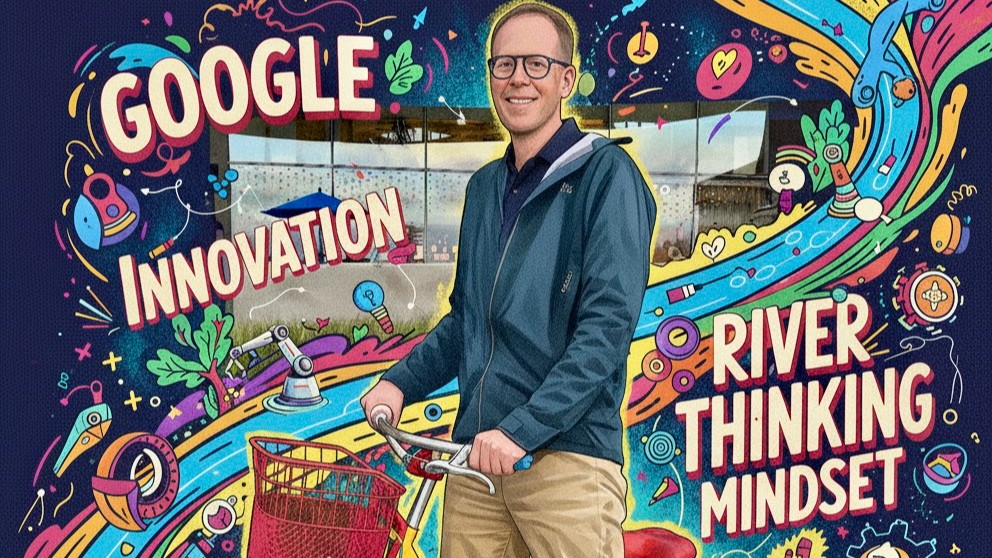
Ed Christie has spent decades training massive companies, like Google, to be more inventive and creative. He teaches humans how to stop relying on tired habits and start making genuine breakthroughs.
So when Google asked him how to pair his creative thinking tricks with AI, I had to know his answer.
I first tried to get a job from Ed fifteen years ago (he didn't hire me. Sad times). Reconnecting recently, the admiration stuck. Over a stream of flat whites (the modern-day pint, perhaps?), I sat down to ask him to teach me, and he delivered a radical new framework. The goal isn't to get AI to do your creativity for you; it's to treat it as a black-t-shirt wearing cool and creative buddy, a silent co-conspirator that nudges you out of the repetitive 'rivers' your mind is trapped in.
This isn't about prompts. It's about a fundamental shift in how we approach thinking. It's about how to finally stop recycling the past and start making something truly new.
Creativity is a Mode (Not a Department)
Ed doesn’t do the mystical “creativity is for artists” schtick. He treats it like a muscle you can train back into life—a mode you deliberately switch on when you need to jump out of the established river.
“Who here was once a child?” he asks boardrooms. Hands go up.
“Right. Then you were creative. My job is retraining you to do what you used to do before school and work beat it out of you.”
That’s the Christie philosophy: creativity isn’t a department, it’s a mode. Something you can deliberately switch on when you need more than the obvious.
The Prisoner of the Past: Rivers of Thinking
Here’s where Ed lights up. He pulls from Edward de Bono, patron saint of lateral thinking, and explains how our brains trap us.
“Your brain’s like a mountainside,” he says. “Every experience is a raindrop. Over time, the drops carve streams, then rivers. So when you face something new, your brain chucks you into one of those rivers. It feels smart—but you’re just recycling the past.”
And suddenly you realise: most brainstorms aren’t brainstorming at all. They’re white-water rafting down the same river, with everyone splashing in unison.
Ed’s rule: know when you’re in the river, then deliberately jump out.
The Escape Plan: Why Randomness Works
De Bono’s classic hack for river-hopping? Randomness. Postcards. Dictionaries. A teaspoon passed round the table. Anything to jar the mind out of its groove.
The only way to jump the river is to introduce this jarring stimulus. And Ed sees AI as a "brilliant engine for that."
“I’ll ask ChatGPT for ten nouns, then pick three. Then I’ll say: invent a food company around them. First time I did it, it gave me a cheese-and-beer matching service delivered by bicycle.” We both laugh. Absurd? Yes. But now you’re somewhere new. You’ve successfully hopped the river.
“Don’t ask AI for an ‘idea’,” Ed warns. “That just deepens the river. Ask for provocations. Ask for random stimulus. Then you do the work.”
Mist vs. Edges: Giving Ideas Definition
You've successfully jumped the river, but now you're in the mist of a new idea. The job isn't done until you give it edges.
One of Ed’s best lines: “Thoughts are mist. Ideas have edges.”
“Ice cream for adults” = mist. “Pina Colada ice cream” = still mist.
Only when you add detail—flavour notes, packaging, the ritual of eating it—does it harden into something you can react to.
In the past, you needed an artist in the room to sketch. Now, AI does the doodling for you. Four visuals in 30 seconds and the room’s suddenly pointing: “Yes to frame two, no to the colour, make it pourable.”
That’s what AI adds: edges on demand.
Greenhousing: The Art of Helping Ideas Grow
The other killer technique Ed pulls from his bag is greenhousing—from WhatIf’s great book Sticky Wisdom (a classic for innovative and creative thinking).
Most ideas don’t die in the pitch. They die in the first five seconds after they’re spoken.
“The moment I say ‘Pina Colada ice cream,’ you’re already evaluating,” Ed says. “You smirk, you nod, you look away. That decides whether I build or shut down.”
Greenhousing flips that: feedback that makes an idea stronger, not smaller. Spot what works → add to it → flag the riskiest assumption → propose a test.
And, of course, AI can play along. You can train it to be blunt-but-kind, Israeli-direct, Japanese-subtle. Whatever keeps the fragile new idea alive long enough to evolve.
Playfulness = Genius Fuel
Here’s Ed’s secret sauce: play.
Stress locks you in the river. Play loosens you up. That sweet alpha brain state—focused but relaxed—is where subconscious sparks fly.
Workshops hit it after the first breakthrough. Coffee houses hit it after flat white two. And yes, AI can help too. “Sometimes I just open Gemini and ask it random stuff for fun,” Ed admits. “No pressure. Just play.”
Because when you’re playful, you’re dangerous—in the best way.
The Three Jobs AI Actually Does Well
By the time we’re finishing our flat whites, Ed’s got it down to three essential jobs AI performs:
1.
Random Stimulus Engine — Blasting you out of the river. 2.
Rapid Real-Maker — Turning the resulting mist into something with edges. 3.
Custom Critic — Greenhousing fragile ideas instead of bulldozing them.
Notice what’s missing? “Do my creativity for me.” That’s the lazy fantasy.
The Black-T-Shirt Buddy
Ed tells me about the best creative duos he’s seen—the art director/copywriter pairs who show up in identical black t-shirts, one thinking in words, one in pictures, sparring without killing the vibe.
That’s how he sees AI. Not the star. Not the genius. The buddy in the black t-shirt sat next to you. The co-conspirator. The sparring partner who nudges you out of the river, sketches your mist, and keeps the game alive.
“Go in with the mindset that AI is your buddy,” Ed shrugs. “That’s when the fun starts. That's when the wow starts too."
If you want to know more about Ed and his brilliant work - do check him out at his consultancy Edit Innovation.