This hasn’t been an easy year. In fact, there were weeks where life felt like juggling chainsaws while being pecked at by pigeons. And in the very worst patch, I remembered something awkward: that’s precisely when I most needed to meditate.
It’s the trickster logic of mindfulness — the last thing you want to do is sit still and watch your thoughts when they’re behaving like caffeinated squirrels. But I dragged myself back to it, and, well, here we are: 200 days in a row.
And something odd happened. Not mystical, not Instagram-worthy. Just… better. More sleep (from 6h50 to 7h30 a night — and yes, I also live with a toddler, so that’s basically a Nobel Prize). Less compulsive doom-scrolling. Fewer explosions of irritation at spilled milk, both metaphorical and the dairy-based variety.
I felt different. But the behavioural science geek in me wanted to know: what was actually happening in my brain and body while I was busy breathing and coaxing my inner monkey to sit back down on its rock?
🐒 The Monkey on the Rock
Biggest misconception? Meditation isn’t “stopping thoughts.” Good luck with that.
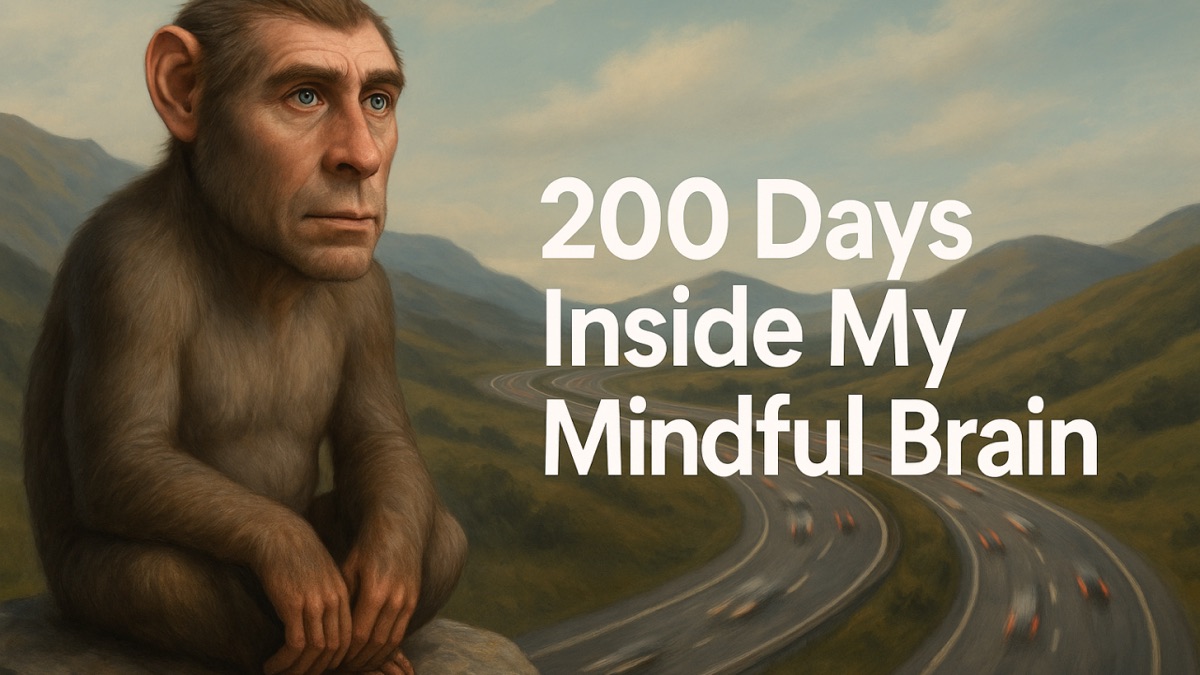
The best analogy I was ever given: your mind is a monkey, sitting on a rock, watching cars go by. The cars are your thoughts. The monkey desperately wants to chase each one. Mindfulness is the act of gently guiding the monkey back to the rock, again and again, kindly, without judgment. The cars still pass. You just stop sprinting after them.
That loop — notice, return, notice, return — is the real muscle. Over time, it reshapes the very networks that govern attention and self-talk (****Nature).
🧠 Renovations Upstairs
Turns out, my brain has been quietly redecorating. Neuroscience shows that regular mindfulness literally remodels the brain (probably).
-
Structural signals: A 2021 systematic review found meditation linked to grey-matter changes — though it also warned about small samples and wobbly methods (PMC). Translation: promising, not gospel.
Functional connectivity: A 2022 meta-analysis shows mindfulness alters brain networks (DMN, salience, frontoparietal), the ones responsible for attention and mind-wandering (Nature).
Amygdala & friends: A 2024 systematic review confirms reductions in amygdala reactivity and thicker prefrontal/insula regions — shorthand for calmer alarms and stronger regulators (PMC).
Net: after months of practice, my “defaults” likely shifted from twitchy-and-scattered toward steadier-and-selective. Not marble sculpture — but measurable rewiring of how networks talk.
⚡ Faster Thinking, Better Puzzles
I thought I was just “a bit sharper.” Turns out, that feeling has backup.
-
A 2023 meta-analysis of 111 RCTs found mindfulness improved attention, executive control, and working memory (PMC).
On creativity, a 2023 review found small but real boosts — especially in convergent thinking (finding neat solutions), with longer interventions doing better (SpringerLink; PubMed).
So yes: after ~200 days, my mental sock drawer feels less like chaos and more like a colour-coded spice rack.
🫀 The Engine Room: Breath & Body
Meanwhile, the body’s been joining the renovation crew.
-
Breathing: Long-term meditators breathe more slowly at rest, and even slower while practising; lifetime practice matters (BioMed Central).
HRV (heart rate variability): An RCT-only meta-analysis found no robust boost in resting HRV across the board (PMC).
So the body’s story: breath slows reliably; HRV improvements depend on who you are and how you practise.
🎉 The Quiet Revolution
Two hundred days in, here’s the science-meets-life verdict:
-
Focus holds longer; mind-wandering is easier to spot and let go (Nature).
Emotion alarms are less hair-trigger; the regulator shows up faster (PMC).
Body rhythms are steadier; breath is calmer; the phone less magnetic (BioMed Central).
Not magic — mechanics. Brains and bodies remodel when you give them steady practice.
And in a world built to scatter our attention like confetti in a hurricane, 200 days of not chasing every passing thought feels less like wellness fluff and more like a quiet revolution.
And yes - I did enjoy the meta element of an article on how you can make your thinking mopre beautiful with mindfulness, inside the Beautiful Thinking newsletter. (Oh - and thank you for subscribing btw!)
Key Sources
-
Pernet et al., 2021 — Mindfulness-related changes in grey matter: a systematic review. (PMC)
Kral et al., 2022 — Absence of structural brain changes from mindfulness training (two RCTs). (Science)
Rahrig et al., 2022 — Meta-analytic evidence that mindfulness alters resting-state connectivity. (Nature)
Calderone et al., 2024 — Neurobiological changes induced by mindfulness and meditation: systematic review. (PMC)
Zainal & Newman, 2023 — Mindfulness enhances cognitive functioning: meta-analysis of 111 RCTs. (PMC)
Hughes et al., 2023 — Mindfulness and creativity: meta-analytical review. (SpringerLink; PubMed)
Karunarathne et al., 2024 — Respiratory function in long-term meditators: systematic review. (BioMed Central)
Brown et al., 2021 — Mindfulness/meditation and vagally mediated HRV: RCT meta-analysis. (PMC)
Jha et al., 2025 — Rajyoga mindfulness meditation RCT in panic disorder: HRV improvements. (PMC)