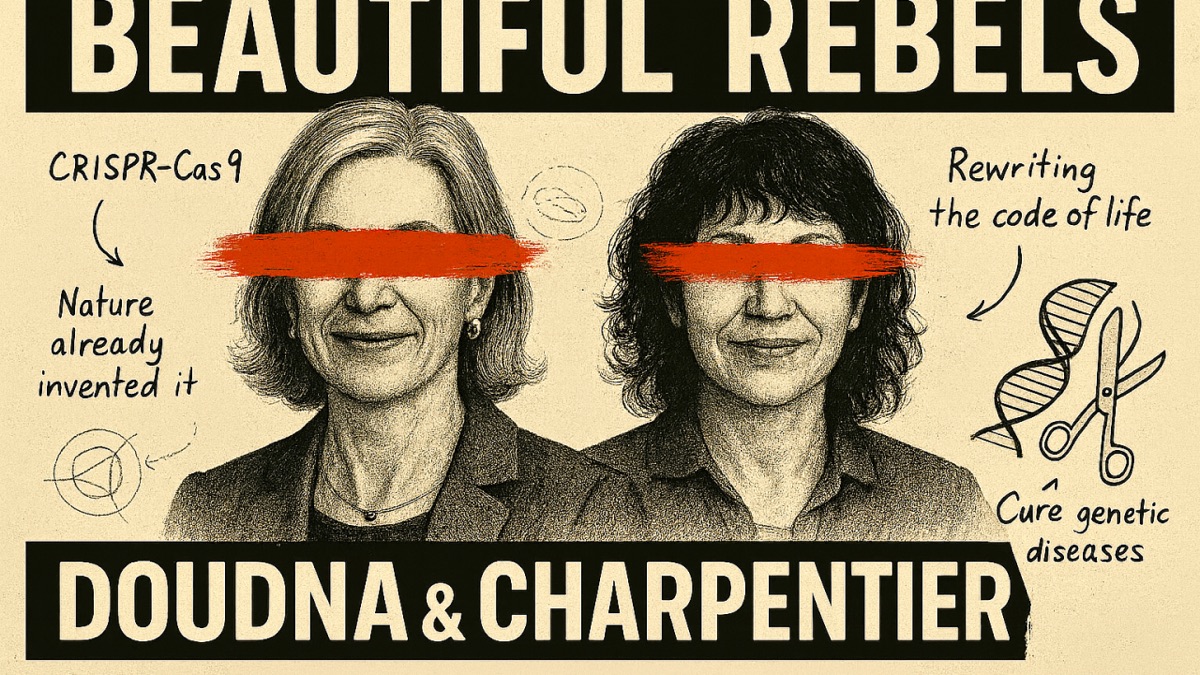
If you wanted to rewrite the code of life—literally change the instructions inside every living cell—you’d need a tool.
Not just any tool. A scalpel so small, so precise, it could snip a single typo in a 3-billion-letter genetic novel without so much as ruffling the page.
For most of history, this was the stuff of science fiction.
Until two women—Jennifer Doudna and Emmanuelle Charpentier—discovered that nature had already built it.
And she’d been hiding it inside bacteria.
Let’s rewind.
For years, scientists had known about strange sequences in bacterial DNA. These were oddly repetitive, palindromic bits of code, like genetic stuttering. Most people ignored them. Too weird. Too useless. Too... bacterial.
But Emmanuelle Charpentier wasn’t most people.
Tucked away in her lab, she was studying Streptococcus pyogenes—yes, the bacteria that gives you strep throat—when she stumbled across a molecule called tracrRNA. It seemed to help the bacteria fight off viruses by guiding a molecular knife called Cas9 to slice the invader’s DNA.
Weird? Absolutely. Beautiful? Also yes.
Enter Jennifer Doudna—an RNA expert with a knack for turning biological puzzles into elegant models. Charpentier invited her to collaborate. The two met in Puerto Rico in 2011, talked shop over dinner, and within months, they were recreating the CRISPR-Cas9 system in a test tube.
And that’s when they realised:
You could program it.
This was no ordinary scientific breakthrough. It was as if someone had found a command line for biology.
For the first time, humans had a cut-and-paste function for DNA. Want to delete a defective gene? Easy. Insert a better one? Sure. Target cancer, cure inherited diseases, fix broken cells? Let’s try.
The tool was so simple, cheap, and adaptable that it spread like wildfire. Labs across the world started editing genomes like they were Google Docs.
Today, CRISPR-Cas9 is already being used to:
-
Cure sickle cell disease and beta thalassemia—once considered life sentences.
Engineer crops that need less water, resist pests, and feed more people.
Fight antibiotic resistance by rewriting bacterial playbooks.
Edit viruses, tweak immune cells, and who knows—maybe even bring back the woolly mammoth (we're not joking).
And all of it began because two women saw potential where others saw bacteria.
Of course, power like this doesn’t come without a catch.
Doudna once had a dream—Hitler was asking her to explain CRISPR. She woke up shaken. Because when you build something that can edit humanity, the question isn’t just can you do it—it’s should you?
So alongside Nobel prizes and headlines, they’ve also become the conscience of gene editing. Advocating for guardrails, ethics, and global agreements on how far is too far.
They didn’t just invent a tool. They triggered a reckoning.
Jennifer Doudna and Emmanuelle Charpentier didn’t hack the genome. They listened to nature and realised she’d already done the hard work. Their genius was in noticing, understanding—and sharing it with the world.
They didn’t storm the gates of biology.
They found the key quietly. Inside a petri dish.
And used it to open the future.