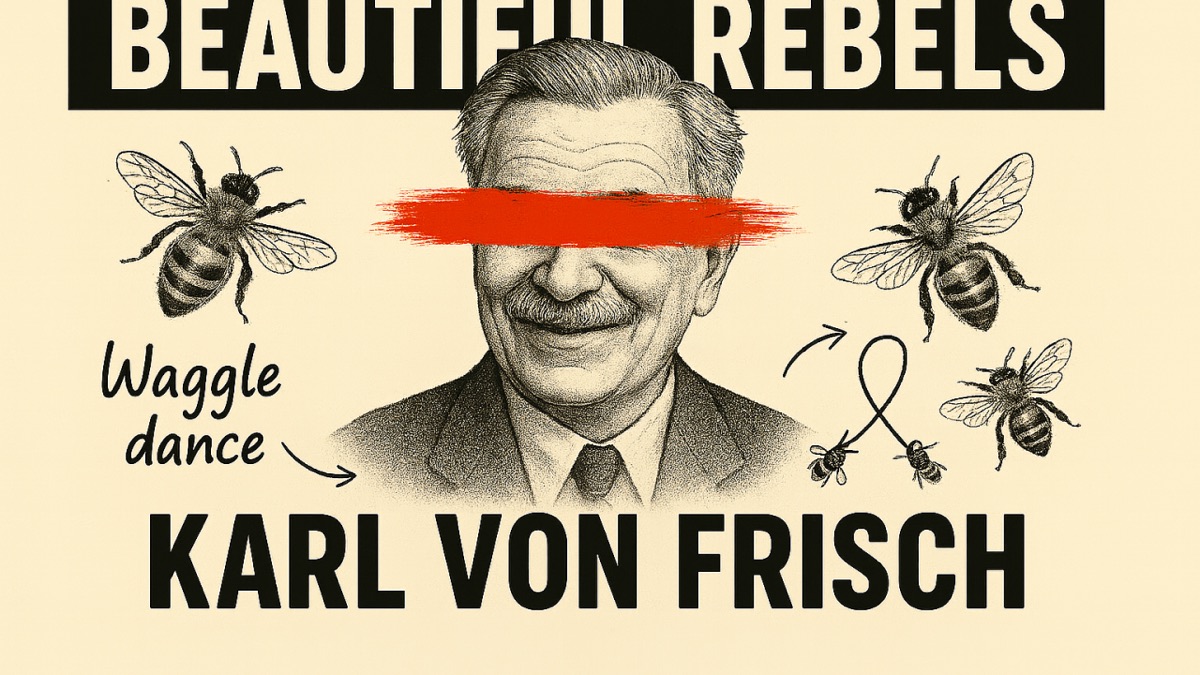
Most scientists were busy giving animals mazes.
Karl von Frisch dared to Bee-lieve they were saying something.
In 1919, while studying honeybees, he noticed something quietly astonishing: a single bee would find food, return to the hive, and move her body in a strange, deliberate pattern—a kind of dance.
Moments later, other bees—who had not seen or smelled the food—flew directly to the source.
Coincidence? He didn’t think so.
Von Frisch believed the bee was communicating. Through dance. On a vertical comb. In near darkness.
It sounded absurd.
But he kept watching.
The Elegant Hypothesis
Von Frisch’s idea was simple—almost too simple for his peers to take seriously:
Bees use movement to share information.
Not scent trails. Not invisible cues. Not some mysterious sixth sense.
Just a dance.
He noticed two core forms:
-
The round dance, used when food was nearby—essentially a little circle of excitement.
The waggle dance, a more elaborate figure-eight with a vibrating central run, used to encode direction and distance.
Direction was communicated by the angle of the waggle run, relative to the sun. Distance was suggested by how long the bee wagged. And the enthusiasm? That told you how good the nectar was.
They weren’t just dancing—they were bee-riefing (too far?!) their colleagues.
A complete system. A symbolic language. In a species without words.
It was less buzz, more blueprint.
What Made It Beautiful
Von Frisch didn’t just observe behavior. He listened to it.
He assumed intelligence where others saw instinct. He looked for pattern where others saw noise.
And through patient, meticulous observation, he built evidence for something astonishing:
That meaning can be transmitted without words
**That language is not only human. **
And that dance—of all things—can be a map.
He found poetry in the pollen.
Why It Still Matters
Von Frisch’s work was among the first to suggest that animals might use symbolic communication—not just reacting to stimuli, but actively encoding and transmitting information.
It cracked open the door to animal cognition. It reshaped how we define language. And it reminded us that beauty often begins with the willingness to watch a little longer, and Bee-lieve a little more.
TL;DR for the quiet rebels:
-
Karl von Frisch believed bees used dance to communicate precise information.
He found a system that appeared to share distance, direction, and quality of food.
His elegant observations suggested that even insects might use symbolic, intentional signals.
That idea changed the study of animal behavior forever—and earned him a Nobel Prize in 1973.
So, next time you see a bee on a blossom, perhaps watch a little longer to see her bee-utiful dance.
💡: If you have your own favourite Beautiful Rebel and want me to do a profile on them, let me know in the comments.