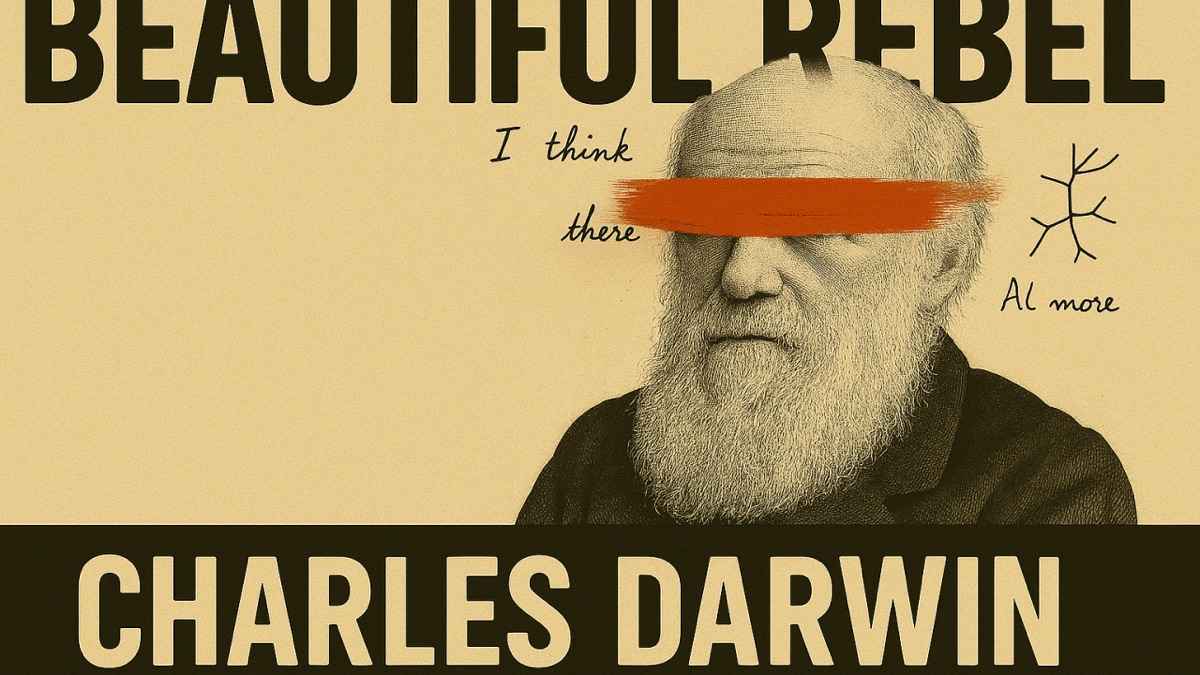
The most beautiful idea the human mind has ever held.
Some ideas don’t just explain the world. They recode it.
This is about those ideas—and the minds behind them. The Beautiful Rebels. Ideas too elegant to ignore. Too inconvenient to accept. Beautiful, because they unlock complexity with grace. Rebels, because they didn’t ask for permission.
They didn’t follow the rules. They rewrote them.
And none rewrote more than Darwin.
We like to imagine genius as sudden. A eureka. A flash of lightning.
But Darwin was no lightning bolt. He was a slow burn. A man who saw something so radical, so exquisitely dangerous, that he kept it secret for decades. Not because he doubted it. Because he understood what it meant.
Here’s what he saw:
Life isn’t fixed. It isn’t static. Every living thing is born with tiny differences. Some of those differences help it survive. Those creatures live longer, breed more, and pass those tiny advantages on.
Do that over and over again—across centuries, across millennia—and those quiet differences stack. They accumulate. They transform.
That’s how you get the eagle’s eye. The delicate curve of an orchid. The opposable thumb. The fear in a rabbit’s eye.
Not magic. Not divine. Mechanism.
A simple, relentless loop: variation, advantage, time. Evolution by natural selection.
A single idea that explains all of life, everywhere. Not just how it works. How it got here.
Darwin knew what he had. He called it “like confessing to a murder.” Because it didn’t just upend biology. It dismantled belief.
He was a man of science, but also of conscience. He knew this idea would shake the Church, society, and—most painfully—his devout wife, Emma. So he waited. He gathered fossils. Raised pigeons. Counted barnacles.
For eight years, he catalogued and dissected barnacles—producing over 1,000 pages of crustacean minutiae. By the end, he was half-mad.
“I hate a barnacle as no man ever did before,” he wrote, “not even a sailor in a slow-sailing ship.”
Obsessive. Ridiculous. Beautiful. But it built the foundation. Because when the real fight came, he wanted the science to be bulletproof.
Then came the letter. A young naturalist—Alfred Russel Wallace—dreaming the same idea in a malaria fever. He sent it to Darwin, asking if it made sense. Darwin’s heart sank. His secret was no longer his alone.
He didn’t rage. He didn’t rush. He felt morally wretched. He insisted they publish together. A joint paper. But it was Darwin’s On the Origin of Species that truly lit the fuse.
And remember: Darwin did all this blind. He had no idea how traits were passed on. Gregor Mendel, the father of genetics, was quietly solving that puzzle. Darwin owned Mendel’s work—unopened on his shelf.
He mapped the architecture of life without ever seeing the blueprints. And he was still right.
Because evolution doesn’t need design. It doesn’t need a creator. It just needs time. And in that time, it sculpts life into something beautiful. Something brutal. Something real.
Darwin didn’t just have a brilliant idea. He carried it carefully, like a man carrying fire.
That’s why he wasn’t just a thinker. He was a Beautiful Rebel.
[If you enjoyed that, and want more hitting your inbox, please do subscribe to my Substack. Link in the comments below 👇👇👇👇👇👇👇]