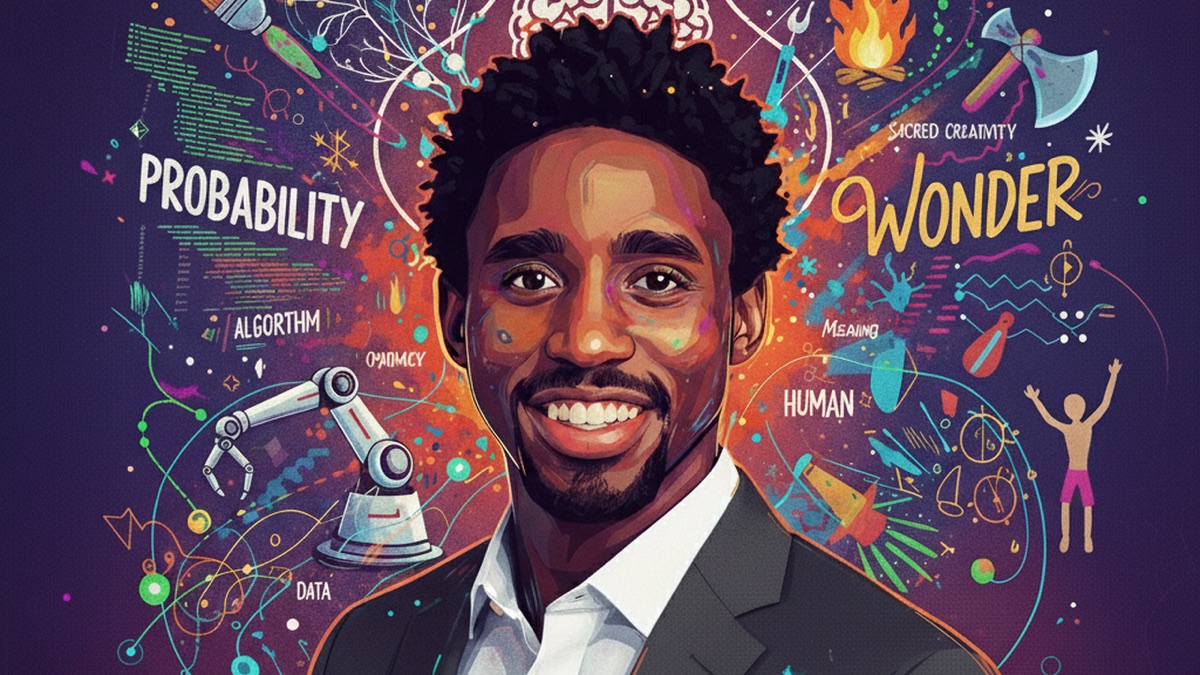
Episode One of the Interview Series on AI x Creativity
When you find someone who works at the exact same weird intersection you do — behavioural science, artificial intelligence, and creativity — you don’t let them slip away.
That’s why I wanted to talk to Stephan Ledain. There are maybe a dozen of us, globally, who hang out at this triple-junction of brains and code and art. We hit it off instantly, like old friends comparing scars. Except instead of swapping stories about schooldays, we were debating Acheulean hand-axes and whether Netflix algorithms qualify as art.
Stephan is calm, articulate, and quietly magnetic. He’s the kind of conversationalist who can take you deep without ever feeling obtuse. Philosophical, yes. But always human. And when he talks about art, you feel his passion for it vibrating through the screen — not art as decoration, but art as meaning.
“There’s an ineffable resistance,” he told me, “to outsourcing creativity to machines. Art feels precious. Human. Sacred.”
Creativity as sacred ground
It’s a line that stops you. Because he’s right: we treat creativity like holy ground. For millennia, making things has been how we’ve made sense of ourselves. Think of those hand-axes carved 100,000 years ago, sharpened all the way around — too impractical to be tools. Our ancestors weren’t optimising for utility; they were chasing beauty. Wonder, not probability.
That was the heart of Stephan’s point:
“AI creates from probability. Humans create from wonder.”
It’s not just a neat turn of phrase. It’s a boundary line. Algorithms remix patterns, optimise aesthetics, spit out statistically pleasing results. Humans, by contrast, stumble toward the ineffable. We create to feel awe — and to provoke it in others. That’s why a painting, a sonnet, or even a well-timed joke can floor you in ways no efficient algorithm can.
Art for the many
I couldn’t resist pushing back. If creativity is sacred, isn’t that just another way of gatekeeping?
Because here’s the counter-story: AI hands the paintbrush to everyone. Even people like me, whose doodles look like cave drawings after three beers. Suddenly anyone can compose a sonnet, make music, or paint like Dalí. This gives art to the many.
Stephan didn’t disagree. He just reminded me that the act of making art — the messy, frustrating, profoundly human act — is as important as the artefact itself. Outsourcing that to machines might open doors, but it might also close something inside us.
The truth, as always, is probably both.
A new medium entirely
If photography was once reviled as a bastardisation of art (spoiler: it now hangs in the Louvre), maybe AI is simply the next medium.
Take Nice Aunties. Her surreal depictions of Asian aunties — part hyper-real, part dreamscape — are impossible without AI. Too complex, too uncanny, too much. It’s not fake painting. It’s a new genre, born of machine possibility.

Stephan loves that too. He wants us to see AI not just as a mimic of painting or writing, but as a new artform altogether — a different lens, like the camera was in 1839.
The selfhood question
And then we veered into dangerous waters. Because once you accept that AI makes things worth looking at, the next question is: who gets the credit?
This is where Stephan gets properly chewy.
Humans have always stolen from each other. Renaissance artists borrowed each other’s tricks. Musicians absorb melodies without realising it. Half of pop music is “accidental plagiarism.” And we forgive it, because we grant humans selfhood. They absorbed the influence, digested it, re-expressed it.
AI doesn’t have that. Not yet. Which makes its output feel like scraping and remixing. A mechanical process, not a human one.
“We’ll feel less inclined to demonise AI art,” Stephan argued, “if we attribute it selfhood. But it doesn’t have that yet. So it feels like reproduction, not creation.”
This matters. Because selfhood is the gateway to credit, rights, culpability. If we collectively decided that AI has a kind of self, then — like humans — it could be forgiven for remixing. Without it, the work always feels borrowed, never born.
That’s not just a philosophical parlour game. It’s a live question for copyright law, creative credit, and cultural legitimacy. Does the coder own the work? The prompter? The platform? Or the machine itself?
Right now, nobody knows.
Probability vs wonder
By the end, I wasn’t left with certainty. I was left with exactly what Stephan believes is at the heart of art: wonder.
Maybe that’s the lesson. AI is already part of our creative ecosystem. It can democratise art, create new mediums, even surprise us. But for now, it still creates from probability. Humans, for all our mess, create from wonder.
And wonder, for now at least, remains sacred.
If you want to find out more about the brilliant Stephan Ledain and his great work - helping businesses adopt AI using behavioural science, or his pioneering work with Art and the community, check out his website - https://www.stephanledain.com/
This was the first episode of Beautiful Thinking: The Interview Series. Next time, a different brain. Same mischief.
And if you know of someone, or you are that someone, who would be great for me to interview on the intersection between AI and Creativity - please do DM me.